A disadvantage of being Vietnamese-American is that my fellow Americans only perceive my ‘American’ side. Holding on tightly to their convictions like a child clutching a teddy bear, I am quickly categorized into the ‘born and raised in the US’ and ‘native English speaker’ categories. But I wasn’t and I’m not. Growing up as a Vietnamese immigrant, I struggled to define myself. To myself, I was a member of the ‘one-and-a-half’ generation, an insider and an outsider, both Vietnamese and American and yet neither simultaneously.
Representing the Peace Corps as an American only highlights my identity insecurities. Ironically, it is not the native Mongolians in this country that raise such issues to the surface but my fellow American PCTs. Maybe it is my young looking face and short twenty-seven years that makes them lump me into the same group experience category as themselves. I wouldn’t mind this inaccuracy too much if it didn’t cause problems, but, as it was in the States and amplified here in Mongolia, this inaccurate label is the root of some of my communication problems.
Nowadays, I speak English without an accent, comprehending the language my in a way my parents still do not. Nonetheless, as a habit of learning English as a second language, I interpret what people say literally and ask many questions to clarify meaning. But English is a tricky language. There are hidden meanings behind the literal words that a native speaker expects another native speaker to understand. And when I don’t, I am quickly tagged as dim-witted and promptly laughed at or worse, made an enemy. A former boyfriend once accused me of “not listening” – a phrase I have heard uttered more frequently in the past two months. My attempt at clarification only causes frustration on the side of the ‘real’ native speaker and such situations usually end in dust clouds of hasty departures.
How ironic is it that in a foreign country, half way around the world from the place that I call home, do I feel more comfortable and accepted then when I’m with fellow Americans.
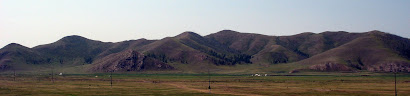
Burengiin Nuruu Mountain Range
Tuesday, July 31, 2007


Saturday, July 28, 2007
Religion: Buddhism and Visit to the Buddhist Monastery, Амарбаясгалант Хийд
Note: The following blog posting on religion is dedicated to my college Theology advisor, a Professor J. Murphy.
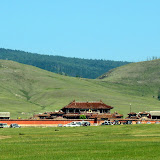
As a part of Cross-Culture Training for PST, all three host community groups had a schedule visit to Amarbayasgalant Khiid (Амарбаясгалант Хийд), one of the top three Buddhist monasteries in Mongolia. Amarbayasgalant Khiid was originally built between 1727 and 1737 by the Manchu emperor Yongzheng and dedicated to the Mongolian Buddhist Zanabazar, whose mummified body was later moved there in 1779. While touring the monastery grounds (27 temples and statues, though only five temples are open to tourists), I couldn’t help but noticed how similar the architecture was to Gyeongbokgung, the main palace of the Joseon Dynasty in Seoul, Korea. From the symmetrical layout to the imperial color scheme, the architecture was distinctively Chinese. I later found out that the monastery was built according to the Manchu style. My earlier thought makes sense given that both Mongolia and South Korea were influenced by the Chinese.
The history of Buddhism has a difficult past in Mongolian history. In 1924, when Bogd Khaan – the 8th Jebtzun Damba (reincarnated spiritual leader of Mongolia) – died, the then communist government prevented a successor from being found. The years of repression that followed peaked in the spring of 1937 when the government ordered the army to destroy religion. The obliteration that followed resulted in 700 monasteries being destroyed and 17,000 monks arrested, never to be seen again. Freedom of religion would not be restored until the democracy movement in 1990, 53 long years later.
Today, around 80% of Mongolians claim to be Buddhist of the Mahayana variety as practiced in Tibet (popularly known as Tibetan Buddhism). However, as culturally observed by curious PCTs, Mongolians tend not to be the practicing kind. In the northern aimags of Khentii, Selenge, Bulgan and Khovsgol, the Buddhism that is practiced is mixed with elements of Shamanism. This is largely because during the time of religious oppression, Shamanism survived because there were no books or buildings to destroy. And later on, with the installation of religious freedom, it co-existed in within the mix of Buddhism.
Two to three generations of Mongolians grew up without Buddhism. Maybe the reason why Mongolians identify themselves as Buddhist even though they don’t practice is because most people no longer understand the Buddhist rituals or their meanings, and the current standing monasteries in Mongolia suffer from a chronic lack of trained Buddhist lamas.
As a part of Cross-Culture Training for PST, all three host community groups had a schedule visit to Amarbayasgalant Khiid (Амарбаясгалант Хийд), one of the top three Buddhist monasteries in Mongolia. Amarbayasgalant Khiid was originally built between 1727 and 1737 by the Manchu emperor Yongzheng and dedicated to the Mongolian Buddhist Zanabazar, whose mummified body was later moved there in 1779. While touring the monastery grounds (27 temples and statues, though only five temples are open to tourists), I couldn’t help but noticed how similar the architecture was to Gyeongbokgung, the main palace of the Joseon Dynasty in Seoul, Korea. From the symmetrical layout to the imperial color scheme, the architecture was distinctively Chinese. I later found out that the monastery was built according to the Manchu style. My earlier thought makes sense given that both Mongolia and South Korea were influenced by the Chinese.
The history of Buddhism has a difficult past in Mongolian history. In 1924, when Bogd Khaan – the 8th Jebtzun Damba (reincarnated spiritual leader of Mongolia) – died, the then communist government prevented a successor from being found. The years of repression that followed peaked in the spring of 1937 when the government ordered the army to destroy religion. The obliteration that followed resulted in 700 monasteries being destroyed and 17,000 monks arrested, never to be seen again. Freedom of religion would not be restored until the democracy movement in 1990, 53 long years later.
Today, around 80% of Mongolians claim to be Buddhist of the Mahayana variety as practiced in Tibet (popularly known as Tibetan Buddhism). However, as culturally observed by curious PCTs, Mongolians tend not to be the practicing kind. In the northern aimags of Khentii, Selenge, Bulgan and Khovsgol, the Buddhism that is practiced is mixed with elements of Shamanism. This is largely because during the time of religious oppression, Shamanism survived because there were no books or buildings to destroy. And later on, with the installation of religious freedom, it co-existed in within the mix of Buddhism.
Two to three generations of Mongolians grew up without Buddhism. Maybe the reason why Mongolians identify themselves as Buddhist even though they don’t practice is because most people no longer understand the Buddhist rituals or their meanings, and the current standing monasteries in Mongolia suffer from a chronic lack of trained Buddhist lamas.
Friday, July 27, 2007
Heat Exhaustion: Mongolian Summers
Mongolia has an extreme climate; it is so far inland that no sea moderates its climate. Only in summer does cloud cover shield the sky but not by much; the sunshine is intense. Before arriving here, I had wondered why Mongolia was nicknamed the “Land of Blue Sky”. With over 260 sunny days a year, even during the 6-8 months of winter, the nickname is understandable.
Lately, it has been really hot. In the past week, the temperature has not dip below the 90F degree mark. Combined with the intense sun, it is no wonder that quite a few of us have been sick; the culprit, most likely being, heat exhaustion. In the States, one can escape the heat by ducking into the nearest building or public bus or moving vehicle, which most likely will be air conditioned. Here, there is no such luck. You would be lucky to find a fan let alone AC. Then there is the strange Mongolian phenomenon of eating hot food during hot sweltering days. There have been countless times I’ve come home from school for lunch in the peak of the hot afternoon to be greeted with steaming soup and boiling tea – right after my host sister comments on how hot it is outside (and in).
Lately, it has been really hot. In the past week, the temperature has not dip below the 90F degree mark. Combined with the intense sun, it is no wonder that quite a few of us have been sick; the culprit, most likely being, heat exhaustion. In the States, one can escape the heat by ducking into the nearest building or public bus or moving vehicle, which most likely will be air conditioned. Here, there is no such luck. You would be lucky to find a fan let alone AC. Then there is the strange Mongolian phenomenon of eating hot food during hot sweltering days. There have been countless times I’ve come home from school for lunch in the peak of the hot afternoon to be greeted with steaming soup and boiling tea – right after my host sister comments on how hot it is outside (and in).
Thursday, July 26, 2007
Wednesday, July 25, 2007
Site Placement Announcements, Part I
With the official site placement announcement less than three weeks away, scheduled for August 9th, a crucial question on our minds is: “where will I be placed?” But more importantly: “who will we be sited next to me?” They tell us that these other 47 strangers in our group will become our good friends over the next two years; they tell us that the other trainees in our host community will become our closest friends; and they tell us that the PCVs sited in our site community will become our best friends. Statements like that make friendships [here] like a lottery, where proximity and chance dictate successful human bonding. Equally as important is preference of a particular geographic location, rolling off our tongues during our site interviews and survey questionnaires, pin-pointing particular providences (Khovd, Hovsgol) or cities (Erdenet, UB); our choices limited to what little we know about those areas.
Although I do share the same curiosity as my fellow trainees, I can’t help think how silly it is to waste such worries on something so minute. For me, my primary concern is not on where I will be living so much as what I will be doing. As a CYD volunteer, I wish to be setup with a Host Country Agency (HCA) that handles direct contact with children, particularly venerable children (i.e. orphans, shelter children, homeless children, children that already have been through the system or have been incarcerated). The PC application process and decisions up to this point were determined with little opinion from me; both the choice of host country and the job sector. If history dictates future, then I know my site placement will be determined based on need rather than personal opinion. Let’s hope I still have the same outlook come August 9th.
Although I do share the same curiosity as my fellow trainees, I can’t help think how silly it is to waste such worries on something so minute. For me, my primary concern is not on where I will be living so much as what I will be doing. As a CYD volunteer, I wish to be setup with a Host Country Agency (HCA) that handles direct contact with children, particularly venerable children (i.e. orphans, shelter children, homeless children, children that already have been through the system or have been incarcerated). The PC application process and decisions up to this point were determined with little opinion from me; both the choice of host country and the job sector. If history dictates future, then I know my site placement will be determined based on need rather than personal opinion. Let’s hope I still have the same outlook come August 9th.
Tuesday, July 24, 2007
M18s: Group Description
It is time to make an introduction to the group I will be spending the next two years with: the M18s. My first impression of them at Staging in Atlanta can be summarized in one word: serious. On average, we are an older group, 48 people total: 5 married couples (one couple in their 40’s, the rest in their 20’s), 3 others above the age of 30 (2 divorcees and one Korean college professor, age unknown), a few hold an MA as well as a BA, a few in their late 20’s with job experience, and the rest recent college graduates ranging from 22-25). When compared to the earlier M17 group (as we were later informed through gossip), we are indeed a toned down group. The sinister tales told were enough to make even Madonna in her prime years blush.
Amongst us we have: a West Point Academy graduate, an experience horseback rider instructor, a published author of four books on Asian geopolitics, a mandolin musician, a certified massage therapist, a former snowmaker at a Maine ski resort, and a former employee on the Gerald R. Ford state funeral planning committee.
And we haven’t lost one yet, although there was a close-call on a medical evacuation; it turned out to be just a nice two week vacation in Thailand, the bastard. The PC worldwide statistics on Early Terminations (ET) (due to medical evacuation, administrative separation, or personal reasons), on average, is four by the end of PST and 20% of the total group before the end of the 27 month time commitment. With eight and a half weeks in country and a week left of PST, our group still retains all original 48 members. Maybe being ‘serious’ has its advantages.
Amongst us we have: a West Point Academy graduate, an experience horseback rider instructor, a published author of four books on Asian geopolitics, a mandolin musician, a certified massage therapist, a former snowmaker at a Maine ski resort, and a former employee on the Gerald R. Ford state funeral planning committee.
And we haven’t lost one yet, although there was a close-call on a medical evacuation; it turned out to be just a nice two week vacation in Thailand, the bastard. The PC worldwide statistics on Early Terminations (ET) (due to medical evacuation, administrative separation, or personal reasons), on average, is four by the end of PST and 20% of the total group before the end of the 27 month time commitment. With eight and a half weeks in country and a week left of PST, our group still retains all original 48 members. Maybe being ‘serious’ has its advantages.
Monday, July 23, 2007
Correspondence Match Program - Know of any teachers?
I am thinking of joining the Correspondence Match Program run by Coverdell World Wise Schools program that sets up correspondence matches with an American classroom teacher with a current serving Peace Corps volunteer. The program aims to educate US kids on learning about another culture – the people, food, music, language, and atmosphere – through the experience of a PCV. I can either be set up with a teacher I already know or through a random match. I currently do not have an educator in mind (that teaches primary to high school
level) and was wondering if you or anyone you knew that was an educator would be interested in participating in this program? All I would need is their name and contact information before I swear-in – August 18, 2007. For more information, please go to the Peace Corps website at: www.peacecorps.gov/wws/correspond
level) and was wondering if you or anyone you knew that was an educator would be interested in participating in this program? All I would need is their name and contact information before I swear-in – August 18, 2007. For more information, please go to the Peace Corps website at: www.peacecorps.gov/wws/
Subscribe to:
Posts (Atom)







.JPG)