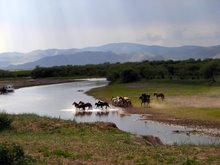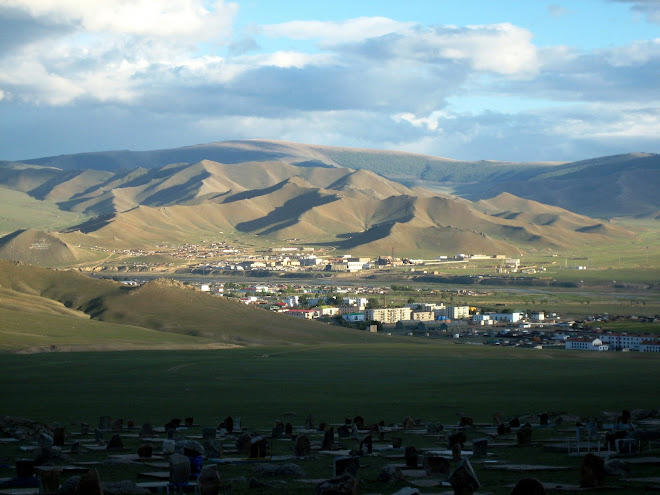
Burengiin Nuruu Mountain Range

Burengiin Nuruu Mountain Range

History of the Peace Corps Program in Mongolia

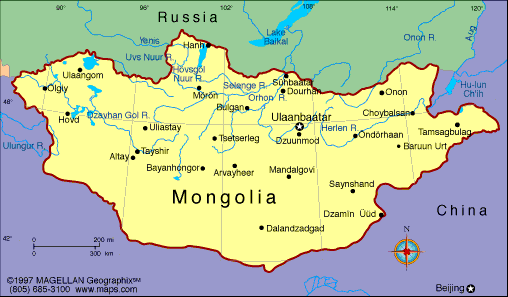
Peace Corps began its program in Mongolia in 1991, the same year the US Embassy opened in Ulaanbaatar, the nation’s capital city. Since then, over 600 Peace Corps Volunteers have served in Mongolia as English language teachers trainers, English teachers, community economic developers, environmental educators, and health educators. I will be a member of the 18th group of Volunteers to serve in Mongolia and the 3rd group of Community Youth Development Volunteers (the 1st CYD Trainees came to Mongolia in June of 2005).

Country Assignment

  • Country: Mongolia (Outter)
  • Program: Youth Development
  • Job Title: Life Skills Trainer (also: English teacher, Child Caretaker, Fund Raiser, Events Organizer, and IT Trainer)
  • Orientation (Staging in Atlanta, GA): May 31-June 2, 2007
  • Pre-Service Training (in Darkhan and Sukhbaatar, Mongolia): June 3-August 18, 2007
  • Dates of Service (in Darkhan at Sun Children formerly "Asian Child Foundation" - a non-profit, non-government Japanese funded orphanage of 37 Mongolian children opened since 8/25/2005): August 19, 2007- August 18, 2009

Location and Nature of the Job

CYD Volunteers are placed in provincial centers with population between 15,000 and 70,000. A few CYD Volunteers are placed in Ulaanbaatar, where the population is reaching 1 million. I will work with youth-focused NGOs, children’s centers, schools, and civil society organizations to address major challenges confronting Mongolian youth today, such as education, life skills, employability, and leadership. In addition, the work will involve workshops and presentations at schools and community agencies and will entail traveling to other outlying communities that have less access to information and training. Given the vast distances in Mongolia, these visits will often require overnight stays.

Showing posts with label Host Community. Show all posts

Wednesday, August 8, 2007

Goodbye to Sukhbaatar, Goodbye My Host Community

Today is my last day in my host community; our group heads back to Darkhan tomorrow for final center days (and Host Family Appreciation Day which will include cultural performances by PCTs (us; had I mentioned earlier that these Mongolians like to deeply embarrass the foreigners?) and a waltz recital (they are really big on the waltz here; an apparent “survival skill” in the khodoo), and then to UB to swear-in on August 18 before scattering to our site communities for the next two years. It has been awhile since a group sweared-in in UB (usually, the ceremony is held in Darkhan) so pray that after six full days in the capital packed with indoor plumping, reliable electricity, a variety of foods and drinks (i.e. hamburgers, pizza, sushi, BBQ, and American beers) and other foreigners (international, not just Americans), our group will remain intact and not sitting in the Country Director’s office waiting for a plane ticket back to the States.

On another note, PST is over; the final LPIs (Language Proficiency Interviews) were given on Monday. I’ve gotten better in the language department; I learned enough “filler” words (i.e. then, and, because, but) to make full meaningful sentences instead of the kidde babble that I was spewing the first three weeks in-country. Although I will greatly miss living with my Mongolian host family (and being pampered and cared for), I am more than ready to be on my own and begin my service. PST is similar to experiencing high school all over again: cliques are formed, gossip is spread, bickering and complaining fluctuates with the heat, handwritten notes are passed, and alcohol debauchery is in fill swing. And, like high school, it is memorable but not an experience one wants to repeat.

As an aide memoire to my host community of Sukhbaatar, I have attached some surrounding landscape pictures. A fellow PCT once described Sukhbaatar as:

“…2 paved roads and zero stoplights. There is an outdoor market attached to an indoor butcher and vegetable vendor. The butcher shop has meat out on counter tops, not refrigerated. Also, most of the butchering is done before your eyes. Cows freely roam around the grassy borders of the city square, and it is more common to see a man riding a horse around town than driving a car. The bars have people passed out in booths or on the bar at any hour of the day, and it is rare to see any kind of law enforcement or police.”

Salomon is correct in his first impressions, though, his first impressions overlook the underline charm that indeed exists within this town. In truth, it took me several weeks to notice it myself. It is in the lady who sells Russian ice cream at the market, the outdoor café that keeps Pringos on hand and blasts popular American music, the colorful jungle gyms that are randomly placed throughout town, the individually owned delguurs unique as the collection of foreign and local items they sell, the man holes without covers (for they have all be stolen to be melted and sold in China), and the occasional cow that freely roams untended. It is the little things that one notices when the first impressions fade away. It is the difference between a traveler and a resident…

I leave you with pictures.


Friday, July 27, 2007

Heat Exhaustion: Mongolian Summers

Mongolia has an extreme climate; it is so far inland that no sea moderates its climate. Only in summer does cloud cover shield the sky but not by much; the sunshine is intense. Before arriving here, I had wondered why Mongolia was nicknamed the “Land of Blue Sky”. With over 260 sunny days a year, even during the 6-8 months of winter, the nickname is understandable.

Lately, it has been really hot. In the past week, the temperature has not dip below the 90F degree mark. Combined with the intense sun, it is no wonder that quite a few of us have been sick; the culprit, most likely being, heat exhaustion. In the States, one can escape the heat by ducking into the nearest building or public bus or moving vehicle, which most likely will be air conditioned. Here, there is no such luck. You would be lucky to find a fan let alone AC. Then there is the strange Mongolian phenomenon of eating hot food during hot sweltering days. There have been countless times I’ve come home from school for lunch in the peak of the hot afternoon to be greeted with steaming soup and boiling tea – right after my host sister comments on how hot it is outside (and in).

Saturday, July 21, 2007

Host Family Trip: Eej Mod (Mother Tree) and Elements of Shamanism

My host family has a habit of planning ‘cultural’ family weekend trips for myself and a fellow PCT, Jason, who’s host family is family friends with mine. Such weekend days are usually told to us at the last minute and, thus, involves a bit of kidnapping (on their part). The last family trip was a fourteen hour adventure to the borders of Mongolia-Russia, the khodoo, and a picnic at Saihnii Hutul (Саихны Хөтөл) National Park. This time, the rendezvous was to Eej Mod (Mother Tree) and basin where the mighty rivers of Orkhon Gol and Selenge Gol meet.

Eej Mod is place where Mongolians often come to seek solace and advice, and make offerings of vodka, milk, and khatag (a blue ceremonial silk scarf symbolizing the bestowal of blessings and good-luck wishes upon those who receive it). Mongolians revere the milk of the five domestic animals (sheep, goat, cow, camel, horse). They wish all things, especially human feelings, would be as white as milk. The color white is the symbol of all things beneficial – happiness, purity, and frankness. Like the ritual preformed when one encounters an ovoos (the large piles of rocks found on mountain passes, repositories of offerings for local sprits), pilgrims ask for a wish to be granted and circle the tree clockwise three times. Legend has it that a pregnant woman, seeking shelter from a heavy rain storm, sought refuge under this particular tree and gave birth to her child, hence the name, Eej Mod (Mother Tree).

Eej Mod (Mother Tree)


Where the mighty rivers of Orkhon Gol and the Selenge Gol meet.


Tuesday, July 3, 2007

Replacing One National Holiday for Another

Happy Independence Day! How odd it will be to celebrate an American holiday so very far away from the county it was meant to commemorate, especially having had celebrated the last seven 4th-of-Julys in Washington, DC. At least I will be amongst a large group of Americans, happy to introduce their fellow Mongolian neighbors to an American tradition. The next three days in Darkhan (away from our host communities) will be a nice break from the intensity of daily language classes and give everyone an opportunity to gather their bearings (i.e. check email that runs at “normal” speeds, stock up on hair conditioner at the local Nomans). The schedule includes a hot shower, ‘barbecue’ (there are rumors of hot dogs and pizza), basketball tournament (PST trainers vs. trainees; pictures from the tournament below), and evening festivities at the familiar Darkhan Hotel bar.


This day also marks the halfway point through PST (Pre-Service Training). The mid-LPIs (Language Proficiency Interviews) were given today (as practice for the final-LPIs in August). My Mongolian – after being in-country for over four weeks and three weeks of intensive language training at four hours a day/five days a week and living with a non-English speaking Mongolian family of five – is worse than my spoken Spanish. Knowing three previous languages before attempting to learn Mongolian actually leaves me at a disadvantage; my brain scrambles the vocabulary in one “dictionary” and what comes out is a combination of confusing phrases and sounds: “Muy Sain!”(Spanish-Mongolian). My tongue was not designed to pronounce “l-th” and “ts” sounds; I am doomed to sound like a blabbing foreigner in my site community for the next two years. For this, I am thankful that my program – CYD (Community Youth Development) – involves me working directly with children; they are far fairer judges of mistakes and blunders.

Naadam is also quickly approaching (July 11), a Mongolian national sports festival that celebrates the “three manly sports” – The Three Main Games of Men – of wrestling, archery, and horseracing. Under the old communist regime Naadam used to be preceded by military parades and workers’ demonstrations in central Ulan Bator’s Sukhbaatar Square (Сүхбаатарын талбай) to mark the anniversary of the establishment in 1921 of Mongolia’s revolutionary government. Nowadays, the three-day festival is held in the city stadium with a colorful ceremony combining national and quasi-religious elements.

Replacing one national holiday for another… Those wrestling underwear are another sight in themselves. I’ll post pictures of the festival as soon as I can.

Tuesday, June 26, 2007

A Taste of Mongolian History: The Legend of Sukhbaatar

The provincial capital of Selenge, the name ‘Sukhbaatar’ translates to “Axe Hero”. In the center of Sukhbaatar square stands a statue of Damdin Sukhbaatar. Sukhbaatar is an important historical figure in Mongolian history, declaring Mongolia’s Independence from China in July 1921. His face dominates many currency notes and there are a number of things that bear his name: the provincial capital (aimag center) of Selenge, a providence (aimag), and a large square in the capital of UB. He was born in 1893, appointed Commander-in-Chief of the Mongolian People’s Revolutionary Army in 1921, and died in 1923 at the age of 30 – quite the busy guy.

One family trip was to Suhkbaatar’s grave and first work place: pictures below.


Saturday, June 23, 2007

A Mission to See Russia, Hiking

When a fellow PCT (Peace Corps Trainee; we are technically not volunteers until we officially swear-in after PST), Jason, asked me if I would be interested in going for a little hike on Saturday, I didn’t hesitate with my affirmation. This “little hike” turned out to be 2.5 hours of an uphill climb across three peaks to reach the endpoint goal of viewing Russia from the highest peak in Sukhbaatar.

Pictures from that day are below:


Monday, June 11, 2007

Unusual Pets

On my second night in my host community of Sukhbaatar (the aimag capital of Selenge, population 20,300), I have discovered that even though it is not common for Mongolians to take dogs in as domestic pets (guard dog duties aside), it is not unlike them have baby black bears as pets. Lead in the house with a leash like a medium-sized dog (which I thought it was at first); the bear provided hours of entertainment for the whole family. Its favorite trick was finger sucking (which I all too soon was going to discover). I wish I had captured that moment down on digital film but I was too busy trying to remember if the Peace Corps Medical Officer had said if one could or could not receive rabies from bear bites.

Sunday, June 10, 2007

Farewell Toilets: Heading Out to the Host Communities

The day we left the Darkhan Hotel for our host communities, it was raining and cold. Dragging our massive suitcases, sleeping bags, water distillers, first-aid kits, and water bottles in the rain to the seven awaiting minibuses only added to our anxiety of being spilt-up among our host communities. The day before, when they had announced our host community locations (Bayangol, Dulaankhaan, and Sukhbaatar) and host families, we had compared notes ooohh-ing and awww-ing at those who had houses with an indoor toilet, vegetable garden, and/or two-story house. The actual reality was an amusing revelation. For those who had the indoor toilets (quite the luxury here in Mongolia), they did not have a shower of any kind and were forced to wash their hair in colorful tubs provided by the Peace Corps (PC). For those who had the pit toilets (aka: outhouses), there was an accompanying outdoor shower. Such quick, drastic changes makes one appreciate the little things in life such as a toilet seat and the feeling of double-ply quitted toilet paper.

Recommended Books on Mongolia

  • “Dateline: An American Journalist in Nomad’s Land” by Michael Kohn, 2006.
  • "Ghengis Khan and the Making of the Modern World” by Jack Weatherford, 2004.
  • “Riding Windhorses” by Sarangerel, 2000.
  • “Twentieth Century Mongolia” by Baabar, 1999.

Recommended Mongolian Movies

  • The Story of the Weeping Camel (2004), Die Geschichte vom Weinenden Kamel
  • Mongolian Ping Pong (2005), Lü cao di