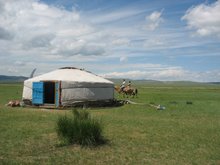
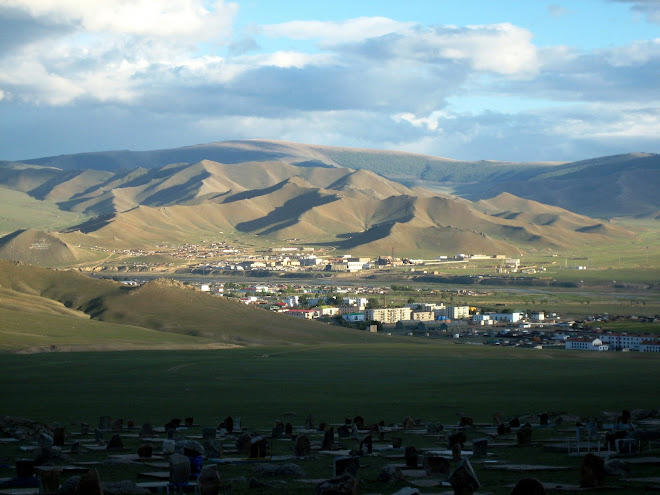
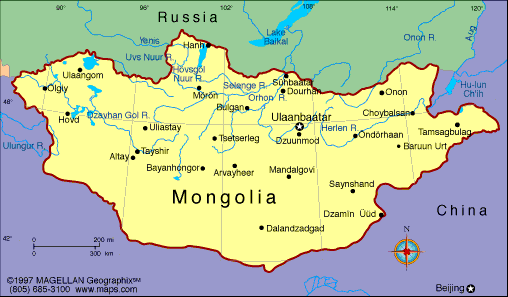
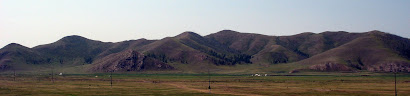
Burengiin Nuruu Mountain Range
Showing posts with label photos. Show all posts
Showing posts with label photos. Show all posts
Friday, November 28, 2008


Sunday, November 25, 2007
Wednesday, October 24, 2007
Rewind and Review: Host Agency Description
I apologize for the lengthy disappearance. The first few weeks at site was very busy, adjusting and settling-in. Then just when the hecticness died down, my laptop caught a nasty virus from a flash drive and preceded to take over all my programs and Windows operating system. I was in a state of near hysterics at this point; broken laptop is one thing but broken laptop in Mongolia when you speak Mongolian badly is a totally scary place to be. After six weeks and some bribing, happy to report that the laptop is up and running and, thus, resumes the blog postings (and pictures). Let me backtrack and rewind:
After swearing-in mid-August, I was sited to Darkhan, my Site Community (2nd largest city in Mongolia; there are only three cities) and assigned to the Asian Child Foundation, my Host Agency (www.happychild.mn only the Mongolian portion is up and running; the English version is still in the works via me). The ACF was founded in August 2005 and operates four programs, two in which I am directly involved with. The 1st is an orphanage that houses 35 children ages 7-19 years old. The hashaa compound (fenced-in area) consists of three buildings, two being the living quarters and the third the arts/language school where traditional Mongolian song and dance, Japanese, and English are taught. Here, I am an English teacher. I am also a child psychologist; I work alongside two other child psychologists. There is also big garden where the children grow their own vegetables, an outhouse, a hashaa dog and dog house, and a basketball court. Soon there will be a sports field (soccer filed, volleyball court, handle bars and swing area); an approved project/grant proposal (written by me within the first three weeks at site; an act of dumb luck, an opportunity taken at the right moment) in conjunction with the US Marines/US Embassy. The materials were brought with US Embassy money and labor provided by the 330rd Mongolian Army.
The 2nd program is the Kindergarten Program. This program provides funding for venerable 60 children ages 1-6 years old to attend the best kindergarten school in Darkhan. In addition to the tradition kindergarten programs that we have in the States, Mongolian kindergarten also acts as nursery; the children are schooled and housed there Monday-Fridays during the day and overnight as well and then are returned to their caretakers on the weekends. These children come from single parent families or families that are in hard financial and extreme living restrains.
That's currently my job, my care and for the first time, I have a job
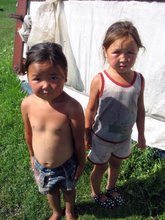
in which I truly feel satisfied. Below are pictures of my kids from the orphanage.


After swearing-in mid-August, I was sited to Darkhan, my Site Community (2nd largest city in Mongolia; there are only three cities) and assigned to the Asian Child Foundation, my Host Agency (www.happychild.mn only the Mongolian portion is up and running; the English version is still in the works via me). The ACF was founded in August 2005 and operates four programs, two in which I am directly involved with. The 1st is an orphanage that houses 35 children ages 7-19 years old. The hashaa compound (fenced-in area) consists of three buildings, two being the living quarters and the third the arts/language school where traditional Mongolian song and dance, Japanese, and English are taught. Here, I am an English teacher. I am also a child psychologist; I work alongside two other child psychologists. There is also big garden where the children grow their own vegetables, an outhouse, a hashaa dog and dog house, and a basketball court. Soon there will be a sports field (soccer filed, volleyball court, handle bars and swing area); an approved project/grant proposal (written by me within the first three weeks at site; an act of dumb luck, an opportunity taken at the right moment) in conjunction with the US Marines/US Embassy. The materials were brought with US Embassy money and labor provided by the 330rd Mongolian Army.
The 2nd program is the Kindergarten Program. This program provides funding for venerable 60 children ages 1-6 years old to attend the best kindergarten school in Darkhan. In addition to the tradition kindergarten programs that we have in the States, Mongolian kindergarten also acts as nursery; the children are schooled and housed there Monday-Fridays during the day and overnight as well and then are returned to their caretakers on the weekends. These children come from single parent families or families that are in hard financial and extreme living restrains.
That's currently my job, my care and for the first time, I have a job
in which I truly feel satisfied. Below are pictures of my kids from the orphanage.


Saturday, August 18, 2007
After Swearing In, Moving-In
Address: Building 1A, Apt #21, New Darkhan, Darkhan Uul, Darkhan Soum, Mongolia
Wednesday, August 8, 2007
Goodbye to Sukhbaatar, Goodbye My Host Community
Today is my last day in my host community; our group heads back to Darkhan tomorrow for final center days (and Host Family Appreciation Day which will include cultural performances by PCTs (us; had I mentioned earlier that these Mongolians like to deeply embarrass the foreigners?) and a waltz recital (they are really big on the waltz here; an apparent “survival skill” in the khodoo), and then to UB to swear-in on August 18 before scattering to our site communities for the next two years. It has been awhile since a group sweared-in in UB (usually, the ceremony is held in Darkhan) so pray that after six full days in the capital packed with indoor plumping, reliable electricity, a variety of foods and drinks (i.e. hamburgers, pizza, sushi, BBQ, and American beers) and other foreigners (international, not just Americans), our group will remain intact and not sitting in the Country Director’s office waiting for a plane ticket back to the States.
On another note, PST is over; the final LPIs (Language Proficiency Interviews) were given on Monday. I’ve gotten better in the language department; I learned enough “filler” words (i.e. then, and, because, but) to make full meaningful sentences instead of the kidde babble that I was spewing the first three weeks in-country. Although I will greatly miss living with my Mongolian host family (and being pampered and cared for), I am more than ready to be on my own and begin my service. PST is similar to experiencing high school all over again: cliques are formed, gossip is spread, bickering and complaining fluctuates with the heat, handwritten notes are passed, and alcohol debauchery is in fill swing. And, like high school, it is memorable but not an experience one wants to repeat.
As an aide memoire to my host community of Sukhbaatar, I have attached some surrounding landscape pictures. A fellow PCT once described Sukhbaatar as:
“…2 paved roads and zero stoplights. There is an outdoor market attached to an indoor butcher and vegetable vendor. The butcher shop has meat out on counter tops, not refrigerated. Also, most of the butchering is done before your eyes. Cows freely roam around the grassy borders of the city square, and it is more common to see a man riding a horse around town than driving a car. The bars have people passed out in booths or on the bar at any hour of the day, and it is rare to see any kind of law enforcement or police.”
Salomon is correct in his first impressions, though, his first impressions overlook the underline charm that indeed exists within this town. In truth, it took me several weeks to notice it myself. It is in the lady who sells Russian ice cream at the market, the outdoor café that keeps Pringos on hand and blasts popular American music, the colorful jungle gyms that are randomly placed throughout town, the individually owned delguurs unique as the collection of foreign and local items they sell, the man holes without covers (for they have all be stolen to be melted and sold in China), and the occasional cow that freely roams untended. It is the little things that one notices when the first impressions fade away. It is the difference between a traveler and a resident…
I leave you with pictures.


On another note, PST is over; the final LPIs (Language Proficiency Interviews) were given on Monday. I’ve gotten better in the language department; I learned enough “filler” words (i.e. then, and, because, but) to make full meaningful sentences instead of the kidde babble that I was spewing the first three weeks in-country. Although I will greatly miss living with my Mongolian host family (and being pampered and cared for), I am more than ready to be on my own and begin my service. PST is similar to experiencing high school all over again: cliques are formed, gossip is spread, bickering and complaining fluctuates with the heat, handwritten notes are passed, and alcohol debauchery is in fill swing. And, like high school, it is memorable but not an experience one wants to repeat.
As an aide memoire to my host community of Sukhbaatar, I have attached some surrounding landscape pictures. A fellow PCT once described Sukhbaatar as:
“…2 paved roads and zero stoplights. There is an outdoor market attached to an indoor butcher and vegetable vendor. The butcher shop has meat out on counter tops, not refrigerated. Also, most of the butchering is done before your eyes. Cows freely roam around the grassy borders of the city square, and it is more common to see a man riding a horse around town than driving a car. The bars have people passed out in booths or on the bar at any hour of the day, and it is rare to see any kind of law enforcement or police.”
Salomon is correct in his first impressions, though, his first impressions overlook the underline charm that indeed exists within this town. In truth, it took me several weeks to notice it myself. It is in the lady who sells Russian ice cream at the market, the outdoor café that keeps Pringos on hand and blasts popular American music, the colorful jungle gyms that are randomly placed throughout town, the individually owned delguurs unique as the collection of foreign and local items they sell, the man holes without covers (for they have all be stolen to be melted and sold in China), and the occasional cow that freely roams untended. It is the little things that one notices when the first impressions fade away. It is the difference between a traveler and a resident…
I leave you with pictures.


Saturday, August 4, 2007
The Cultural Gift of a Del, Made With a Mother’s Loving Hands
For the past four days, my Mongolian host mother has been busy handmaking my del.
A brief interruption for a cultural explanation:
A del is the Mongol’s traditional garment worn on both workdays and special days. It is a long, loose gown cut one piece with the sleeves; it has a high collar and widely overlaps at the front. The del is girdled with a sash. Each ethnic group living in Mongolia has its own del distinguished by cut, color, and trimming. With the increase in European dress, especially with the women, the del has evolved to adapt to the frequent demands of the latest fashion, ranging in colors and choice of fabric as well as in the elegance of the cut and originality of the trimmings.
As I was saying, my host mother has been sewing my del on an old-fashion portable sewing machine that she hand-cranks with her right hand while pushing the material to be sewn (without the help of pins) with her left. I am amazed at how she manages to create perfect straight lines and design a dress pattern that fits flawlessly without the help of a measuring tape.
Watching her work, I am greatly reminded of my biological mother. My Mongolian host mother greatly resembles my Vietnamese biological mother. They both have a penchant for bubble gum colored lipstick. They both are masters at sewing, even owning similar old-fashion black sewing machines adorned with hand-painted flowers. Even their kisses are the same; the tender ‘sniff’ of the nose to the receiver’s cheek – a trait I had previously only associated to Vietnamese culture but now realized existed elsewhere; its origin remain unknown.
I am excited to wear the finish product, an honor I will save for my swearing-in ceremony in UB. Then, I will not only look the part of a Mongolian but I will feel like one too.

A brief interruption for a cultural explanation:
A del is the Mongol’s traditional garment worn on both workdays and special days. It is a long, loose gown cut one piece with the sleeves; it has a high collar and widely overlaps at the front. The del is girdled with a sash. Each ethnic group living in Mongolia has its own del distinguished by cut, color, and trimming. With the increase in European dress, especially with the women, the del has evolved to adapt to the frequent demands of the latest fashion, ranging in colors and choice of fabric as well as in the elegance of the cut and originality of the trimmings.
As I was saying, my host mother has been sewing my del on an old-fashion portable sewing machine that she hand-cranks with her right hand while pushing the material to be sewn (without the help of pins) with her left. I am amazed at how she manages to create perfect straight lines and design a dress pattern that fits flawlessly without the help of a measuring tape.
Watching her work, I am greatly reminded of my biological mother. My Mongolian host mother greatly resembles my Vietnamese biological mother. They both have a penchant for bubble gum colored lipstick. They both are masters at sewing, even owning similar old-fashion black sewing machines adorned with hand-painted flowers. Even their kisses are the same; the tender ‘sniff’ of the nose to the receiver’s cheek – a trait I had previously only associated to Vietnamese culture but now realized existed elsewhere; its origin remain unknown.
I am excited to wear the finish product, an honor I will save for my swearing-in ceremony in UB. Then, I will not only look the part of a Mongolian but I will feel like one too.

Saturday, July 28, 2007
Religion: Buddhism and Visit to the Buddhist Monastery, Амарбаясгалант Хийд
Note: The following blog posting on religion is dedicated to my college Theology advisor, a Professor J. Murphy.
As a part of Cross-Culture Training for PST, all three host community groups had a schedule visit to Amarbayasgalant Khiid (Амарбаясгалант Хийд), one of the top three Buddhist monasteries in Mongolia. Amarbayasgalant Khiid was originally built between 1727 and 1737 by the Manchu emperor Yongzheng and dedicated to the Mongolian Buddhist Zanabazar, whose mummified body was later moved there in 1779. While touring the monastery grounds (27 temples and statues, though only five temples are open to tourists), I couldn’t help but noticed how similar the architecture was to Gyeongbokgung, the main palace of the Joseon Dynasty in Seoul, Korea. From the symmetrical layout to the imperial color scheme, the architecture was distinctively Chinese. I later found out that the monastery was built according to the Manchu style. My earlier thought makes sense given that both Mongolia and South Korea were influenced by the Chinese.
The history of Buddhism has a difficult past in Mongolian history. In 1924, when Bogd Khaan – the 8th Jebtzun Damba (reincarnated spiritual leader of Mongolia) – died, the then communist government prevented a successor from being found. The years of repression that followed peaked in the spring of 1937 when the government ordered the army to destroy religion. The obliteration that followed resulted in 700 monasteries being destroyed and 17,000 monks arrested, never to be seen again. Freedom of religion would not be restored until the democracy movement in 1990, 53 long years later.
Today, around 80% of Mongolians claim to be Buddhist of the Mahayana variety as practiced in Tibet (popularly known as Tibetan Buddhism). However, as culturally observed by curious PCTs, Mongolians tend not to be the practicing kind. In the northern aimags of Khentii, Selenge, Bulgan and Khovsgol, the Buddhism that is practiced is mixed with elements of Shamanism. This is largely because during the time of religious oppression, Shamanism survived because there were no books or buildings to destroy. And later on, with the installation of religious freedom, it co-existed in within the mix of Buddhism.
Two to three generations of Mongolians grew up without Buddhism. Maybe the reason why Mongolians identify themselves as Buddhist even though they don’t practice is because most people no longer understand the Buddhist rituals or their meanings, and the current standing monasteries in Mongolia suffer from a chronic lack of trained Buddhist lamas.
As a part of Cross-Culture Training for PST, all three host community groups had a schedule visit to Amarbayasgalant Khiid (Амарбаясгалант Хийд), one of the top three Buddhist monasteries in Mongolia. Amarbayasgalant Khiid was originally built between 1727 and 1737 by the Manchu emperor Yongzheng and dedicated to the Mongolian Buddhist Zanabazar, whose mummified body was later moved there in 1779. While touring the monastery grounds (27 temples and statues, though only five temples are open to tourists), I couldn’t help but noticed how similar the architecture was to Gyeongbokgung, the main palace of the Joseon Dynasty in Seoul, Korea. From the symmetrical layout to the imperial color scheme, the architecture was distinctively Chinese. I later found out that the monastery was built according to the Manchu style. My earlier thought makes sense given that both Mongolia and South Korea were influenced by the Chinese.
The history of Buddhism has a difficult past in Mongolian history. In 1924, when Bogd Khaan – the 8th Jebtzun Damba (reincarnated spiritual leader of Mongolia) – died, the then communist government prevented a successor from being found. The years of repression that followed peaked in the spring of 1937 when the government ordered the army to destroy religion. The obliteration that followed resulted in 700 monasteries being destroyed and 17,000 monks arrested, never to be seen again. Freedom of religion would not be restored until the democracy movement in 1990, 53 long years later.
Today, around 80% of Mongolians claim to be Buddhist of the Mahayana variety as practiced in Tibet (popularly known as Tibetan Buddhism). However, as culturally observed by curious PCTs, Mongolians tend not to be the practicing kind. In the northern aimags of Khentii, Selenge, Bulgan and Khovsgol, the Buddhism that is practiced is mixed with elements of Shamanism. This is largely because during the time of religious oppression, Shamanism survived because there were no books or buildings to destroy. And later on, with the installation of religious freedom, it co-existed in within the mix of Buddhism.
Two to three generations of Mongolians grew up without Buddhism. Maybe the reason why Mongolians identify themselves as Buddhist even though they don’t practice is because most people no longer understand the Buddhist rituals or their meanings, and the current standing monasteries in Mongolia suffer from a chronic lack of trained Buddhist lamas.
Saturday, July 21, 2007
Host Family Trip: Eej Mod (Mother Tree) and Elements of Shamanism
My host family has a habit of planning ‘cultural’ family weekend trips for myself and a fellow PCT, Jason, who’s host family is family friends with mine. Such weekend days are usually told to us at the last minute and, thus, involves a bit of kidnapping (on their part). The last family trip was a fourteen hour adventure to the borders of Mongolia-Russia, the khodoo, and a picnic at Saihnii Hutul (Саихны Хөтөл) National Park. This time, the rendezvous was to Eej Mod (Mother Tree) and basin where the mighty rivers of Orkhon Gol and Selenge Gol meet.
Eej Mod is place where Mongolians often come to seek solace and advice, and make offerings of vodka, milk, and khatag (a blue ceremonial silk scarf symbolizing the bestowal of blessings and good-luck wishes upon those who receive it). Mongolians revere the milk of the five domestic animals (sheep, goat, cow, camel, horse). They wish all things, especially human feelings, would be as white as milk. The color white is the symbol of all things beneficial – happiness, purity, and frankness. Like the ritual preformed when one encounters an ovoos (the large piles of rocks found on mountain passes, repositories of offerings for local sprits), pilgrims ask for a wish to be granted and circle the tree clockwise three times. Legend has it that a pregnant woman, seeking shelter from a heavy rain storm, sought refuge under this particular tree and gave birth to her child, hence the name, Eej Mod (Mother Tree).
Eej Mod (Mother Tree)


Where the mighty rivers of Orkhon Gol and the Selenge Gol meet.


Eej Mod is place where Mongolians often come to seek solace and advice, and make offerings of vodka, milk, and khatag (a blue ceremonial silk scarf symbolizing the bestowal of blessings and good-luck wishes upon those who receive it). Mongolians revere the milk of the five domestic animals (sheep, goat, cow, camel, horse). They wish all things, especially human feelings, would be as white as milk. The color white is the symbol of all things beneficial – happiness, purity, and frankness. Like the ritual preformed when one encounters an ovoos (the large piles of rocks found on mountain passes, repositories of offerings for local sprits), pilgrims ask for a wish to be granted and circle the tree clockwise three times. Legend has it that a pregnant woman, seeking shelter from a heavy rain storm, sought refuge under this particular tree and gave birth to her child, hence the name, Eej Mod (Mother Tree).
Eej Mod (Mother Tree)


Where the mighty rivers of Orkhon Gol and the Selenge Gol meet.


Friday, July 20, 2007
The Pressures of Alcohol in Mongolian Culture and How to Properly Accept a Vodka Offering
The subject of alcohol pressure and alcohol consumption in Mongolia had thoroughly been discussed prior to our arrival into our host communities. Warnings were given and demonstration of alcohol refusal was shown but wouldn’t you know it, it did no good. It is not easy to convince a Mongolian that you do not want to drink alcohol. Rather than make excuses and getting called ‘muu’ (‘bad’, which has happened several times), it is much easier to go through the motions, put the cup to my lips, sip as much as I can bear and pass the cup back to my host. Elders instruct the youth to: “Taste alcohol barely in the prime of life”; Drink alcohol moderately in the maturity of life”; Drink alcohol enjoyably in older age,” however, the actual practice is a bit different.
When one is offered vodka (before the first round for it is also tradition to take three rounds of vodka; one cannot just get away with the courtesy one shot), there is a short ritual to honor Father Heaven, Mother Earth, and the ancestors. The ritual goes: dip your ring finger of your right hand (‘yadam khuruu’) into the glass, and lightly flick a drip once towards the sky, once towards the air ‘to the wind’ and once to the ground, and end with a wipe across your forehead. This expresses the following meaning:
Be serene, the blue sky!
Be calm, the hole earth!
Be contented, humankind!
Food and drink are accepted with the right hand; the left hand is only used to support the right elbow. Similarly, offerings are presented this way as well. Demonstration picture below (although this picture is slightly wrong – you can tell we are still in the learning stages; the host usually has the offering poured before presenting it, never does he let the guest hold the glass while he pours).

When one is offered vodka (before the first round for it is also tradition to take three rounds of vodka; one cannot just get away with the courtesy one shot), there is a short ritual to honor Father Heaven, Mother Earth, and the ancestors. The ritual goes: dip your ring finger of your right hand (‘yadam khuruu’) into the glass, and lightly flick a drip once towards the sky, once towards the air ‘to the wind’ and once to the ground, and end with a wipe across your forehead. This expresses the following meaning:
Be serene, the blue sky!
Be calm, the hole earth!
Be contented, humankind!
Food and drink are accepted with the right hand; the left hand is only used to support the right elbow. Similarly, offerings are presented this way as well. Demonstration picture below (although this picture is slightly wrong – you can tell we are still in the learning stages; the host usually has the offering poured before presenting it, never does he let the guest hold the glass while he pours).

Tuesday, July 17, 2007
Host Family Tragedy: A Death in the Family
My host family recently experienced a death in the family; my grandfather on my mother’s side pasted away three and a half weeks ago, a week before mid-LPI and mid-center days in Darkhan. His passing came at a very bad time for there was a series of ‘bad news’ events that happened around the same time (i.e. my other grandfather on my father’s side fell really ill and had to be taken to a hospital in UB, the family had received news that their pervious PCV had ET (Early Terminate)). I suppose the American saying “when it rains, it pours” is appropriate here. With the sudden trip to UB and the unexpected passing of my grandfather combined with my week long absence between mid-center days in Darkhan and CYD training at Summer Labor Camp near Erdenet, I hardly saw my family for over two weeks, especially my eej (mother). And when I did see her again – two and half weeks after her father had passed – she was (still) crying, laying in the living room covered with blankets and head compresses, inconsolable.
The funeral was held in the khodoo (countryside), where my grandfather had lived and died. Since the funeral took place the day before my mid-LPI and two days before I left for Darkhan, I could not attend. The night before the funeral, the remainder of my family – two younger brothers and a younger sister – left for the khodoo. Up to this point, it had only been my host parents who had been away to be with the rest of the other family members. I, in turn, was left in good hands; my brother’s friend stayed two nights to guard the house and my sister’s friend came by the morning to cook me breakfast, lunch, and dinner, and help me prepare for my mid-LPI then left to go back to her house.
This all had happened before I received cross-culture training in the rituals of Mongolian funerals and passings, thus, I had no idea of what to do or what to say, if anything. So I did the one thing that came to mind, I gave a sentimental ‘happy gift’, one that I was going to save until end of PST but decided that now was a better time; I gave the gift of photographs (Mongolians absolutely love photographs; digital cameras and personal computers are rare here so hand-held glossy photographs are still treasured). Seventeen beautifully developed colorful photographs of a family trip to the Mongolia-Russian boarder, the khodoo (which included horseback riding, goat chasing, Mongolian song singing, a ger visit), and a picnic in Sainnii Hutul Peak National Park. My pictures now sit in a photo album all by themselves and proudly brought out with every new visitor to the house.
Some are displayed below:
.jpg)
.jpg)
.JPG)
.jpg)

The funeral was held in the khodoo (countryside), where my grandfather had lived and died. Since the funeral took place the day before my mid-LPI and two days before I left for Darkhan, I could not attend. The night before the funeral, the remainder of my family – two younger brothers and a younger sister – left for the khodoo. Up to this point, it had only been my host parents who had been away to be with the rest of the other family members. I, in turn, was left in good hands; my brother’s friend stayed two nights to guard the house and my sister’s friend came by the morning to cook me breakfast, lunch, and dinner, and help me prepare for my mid-LPI then left to go back to her house.
This all had happened before I received cross-culture training in the rituals of Mongolian funerals and passings, thus, I had no idea of what to do or what to say, if anything. So I did the one thing that came to mind, I gave a sentimental ‘happy gift’, one that I was going to save until end of PST but decided that now was a better time; I gave the gift of photographs (Mongolians absolutely love photographs; digital cameras and personal computers are rare here so hand-held glossy photographs are still treasured). Seventeen beautifully developed colorful photographs of a family trip to the Mongolia-Russian boarder, the khodoo (which included horseback riding, goat chasing, Mongolian song singing, a ger visit), and a picnic in Sainnii Hutul Peak National Park. My pictures now sit in a photo album all by themselves and proudly brought out with every new visitor to the house.
Some are displayed below:
.jpg)
.jpg)
.JPG)
.jpg)

Wednesday, July 11, 2007
Naadam – “The Three Manly Sports” (Erinn Gurvan Naadam)
1. Wrestling
Wrestling is national sport of Mongolia; it is the highlight of the Three Games of Men during Naadam (July 11-13). There are no weight categories or age limits in Mongolian national wrestling and during Naadam, every willing and curious man is given an equal chance to compete (including the American PC boys of Dulaankhaan host community; video footage link yet to be posted). The wrestlers wear heavy boots, a very small tight-fitting loincloth, a pair of sleeves which meet across the back of the shoulders resembling a tiny vestige of a jacket, and a pointed cap of velvet. It is rumored that this “uniform” came to be because during one Naadam, a woman had beaten all the contestants (wrestling is the one sport during Naadam that is reserved only for men to participate). The contestants come out on the field leaping and dancing, flapping their arms in imitation of an eagle (the “Eagle Dance”), then slaps with both hands his thighs and buttocks – a sign to his opponent that he is ready to begin.


2. Horse Racing
Mongolia’s second-biggest sport is horse racing. Jockeys are children between the ages of five and 12 (Mongolian children have been riding since infancy; “The nomad is born in the saddle”), racing their horses over open countryside rather than around a track; courses range from 15km-30km, depending on the age of the horses. The winning horse receives the honorary tile of ‘tumnii ek’ or ‘leader of 10,000’.


3. Archery
Archers use a bent composite bow made of layered horn, bark and wood. Arrows are made of willow and feathers from vultures and other birds of prey. The distance is 75m for men and 60m for women. Men shoot 40 arrows and must score greater than 15 points; women shoot 20 arrows and must score great than 13 points using the same bow. The winner earns the title of ‘mergeb’ or ‘super marksman’.
Wrestling is national sport of Mongolia; it is the highlight of the Three Games of Men during Naadam (July 11-13). There are no weight categories or age limits in Mongolian national wrestling and during Naadam, every willing and curious man is given an equal chance to compete (including the American PC boys of Dulaankhaan host community; video footage link yet to be posted). The wrestlers wear heavy boots, a very small tight-fitting loincloth, a pair of sleeves which meet across the back of the shoulders resembling a tiny vestige of a jacket, and a pointed cap of velvet. It is rumored that this “uniform” came to be because during one Naadam, a woman had beaten all the contestants (wrestling is the one sport during Naadam that is reserved only for men to participate). The contestants come out on the field leaping and dancing, flapping their arms in imitation of an eagle (the “Eagle Dance”), then slaps with both hands his thighs and buttocks – a sign to his opponent that he is ready to begin.


2. Horse Racing
Mongolia’s second-biggest sport is horse racing. Jockeys are children between the ages of five and 12 (Mongolian children have been riding since infancy; “The nomad is born in the saddle”), racing their horses over open countryside rather than around a track; courses range from 15km-30km, depending on the age of the horses. The winning horse receives the honorary tile of ‘tumnii ek’ or ‘leader of 10,000’.


3. Archery
Archers use a bent composite bow made of layered horn, bark and wood. Arrows are made of willow and feathers from vultures and other birds of prey. The distance is 75m for men and 60m for women. Men shoot 40 arrows and must score greater than 15 points; women shoot 20 arrows and must score great than 13 points using the same bow. The winner earns the title of ‘mergeb’ or ‘super marksman’.
Sunday, July 8, 2007
An Ode to Mongolia: Summer Labor Camp, Түмэн Од Хөдөпмөр Зуслан
As a part of CYD training, I was forced to attend Summer Labor Camp out into the khodoo (near Erdenet – the 2nd largest city in the providence or aimag of Bulgan, population 75,100) for three days and three nights. Fortunately, this was not my first trip to the khodoo and I had already been made familiar with the rituals of ger visitation (and airag drinking). To commemorate my second trip to the khodoo, I rewrote the chorus to a beloved American song to fit my new home:
Dirt road, take me home
To the place, I belong
Mongolia, khodoo mama
Take me home
Dirt road
Camp activities included daily water fletching from the river 100 yards from site, chopping wood into thin pieces, help cook three meals a day for a group thirty-four 12-14 year olds and twenty adults using just a wood stove, picking wild strawberries, a two-hour long scavenger hunt, horseback riding, building 12-foot bonfires, and playing soccer and basketball (the number of American pro jerseys I saw would have been enough to compile a professional basketball team of their own).


Dirt road, take me home
To the place, I belong
Mongolia, khodoo mama
Take me home
Dirt road
Camp activities included daily water fletching from the river 100 yards from site, chopping wood into thin pieces, help cook three meals a day for a group thirty-four 12-14 year olds and twenty adults using just a wood stove, picking wild strawberries, a two-hour long scavenger hunt, horseback riding, building 12-foot bonfires, and playing soccer and basketball (the number of American pro jerseys I saw would have been enough to compile a professional basketball team of their own).


Tuesday, July 3, 2007
Replacing One National Holiday for Another
Happy Independence Day! How odd it will be to celebrate an American holiday so very far away from the county it was meant to commemorate, especially having had celebrated the last seven 4th-of-Julys in Washington, DC. At least I will be amongst a large group of Americans, happy to introduce their fellow Mongolian neighbors to an American tradition. The next three days in Darkhan (away from our host communities) will be a nice break from the intensity of daily language classes and give everyone an opportunity to gather their bearings (i.e. check email that runs at “normal” speeds, stock up on hair conditioner at the local Nomans). The schedule includes a hot shower, ‘barbecue’ (there are rumors of hot dogs and pizza), basketball tournament (PST trainers vs. trainees; pictures from the tournament below), and evening festivities at the familiar Darkhan Hotel bar.
.jpg)
.jpg)
.jpg)
This day also marks the halfway point through PST (Pre-Service Training). The mid-LPIs (Language Proficiency Interviews) were given today (as practice for the final-LPIs in August). My Mongolian – after being in-country for over four weeks and three weeks of intensive language training at four hours a day/five days a week and living with a non-English speaking Mongolian family of five – is worse than my spoken Spanish. Knowing three previous languages before attempting to learn Mongolian actually leaves me at a disadvantage; my brain scrambles the vocabulary in one “dictionary” and what comes out is a combination of confusing phrases and sounds: “Muy Sain!”(Spanish-Mongolian). My tongue was not designed to pronounce “l-th” and “ts” sounds; I am doomed to sound like a blabbing foreigner in my site community for the next two years. For this, I am thankful that my program – CYD (Community Youth Development) – involves me working directly with children; they are far fairer judges of mistakes and blunders.
Naadam is also quickly approaching (July 11), a Mongolian national sports festival that celebrates the “three manly sports” – The Three Main Games of Men – of wrestling, archery, and horseracing. Under the old communist regime Naadam used to be preceded by military parades and workers’ demonstrations in central Ulan Bator’s Sukhbaatar Square (Сүхбаатарын талбай) to mark the anniversary of the establishment in 1921 of Mongolia’s revolutionary government. Nowadays, the three-day festival is held in the city stadium with a colorful ceremony combining national and quasi-religious elements.
Replacing one national holiday for another… Those wrestling underwear are another sight in themselves. I’ll post pictures of the festival as soon as I can.
.jpg)
.jpg)
.jpg)
This day also marks the halfway point through PST (Pre-Service Training). The mid-LPIs (Language Proficiency Interviews) were given today (as practice for the final-LPIs in August). My Mongolian – after being in-country for over four weeks and three weeks of intensive language training at four hours a day/five days a week and living with a non-English speaking Mongolian family of five – is worse than my spoken Spanish. Knowing three previous languages before attempting to learn Mongolian actually leaves me at a disadvantage; my brain scrambles the vocabulary in one “dictionary” and what comes out is a combination of confusing phrases and sounds: “Muy Sain!”(Spanish-Mongolian). My tongue was not designed to pronounce “l-th” and “ts” sounds; I am doomed to sound like a blabbing foreigner in my site community for the next two years. For this, I am thankful that my program – CYD (Community Youth Development) – involves me working directly with children; they are far fairer judges of mistakes and blunders.
Naadam is also quickly approaching (July 11), a Mongolian national sports festival that celebrates the “three manly sports” – The Three Main Games of Men – of wrestling, archery, and horseracing. Under the old communist regime Naadam used to be preceded by military parades and workers’ demonstrations in central Ulan Bator’s Sukhbaatar Square (Сүхбаатарын талбай) to mark the anniversary of the establishment in 1921 of Mongolia’s revolutionary government. Nowadays, the three-day festival is held in the city stadium with a colorful ceremony combining national and quasi-religious elements.
Replacing one national holiday for another… Those wrestling underwear are another sight in themselves. I’ll post pictures of the festival as soon as I can.
Tuesday, June 26, 2007
A Taste of Mongolian History: The Legend of Sukhbaatar
The provincial capital of Selenge, the name ‘Sukhbaatar’ translates to “Axe Hero”. In the center of Sukhbaatar square stands a statue of Damdin Sukhbaatar. Sukhbaatar is an important historical figure in Mongolian history, declaring Mongolia’s Independence from China in July 1921. His face dominates many currency notes and there are a number of things that bear his name: the provincial capital (aimag center) of Selenge, a providence (aimag), and a large square in the capital of UB. He was born in 1893, appointed Commander-in-Chief of the Mongolian People’s Revolutionary Army in 1921, and died in 1923 at the age of 30 – quite the busy guy.
One family trip was to Suhkbaatar’s grave and first work place: pictures below.
.JPG)
.JPG)
One family trip was to Suhkbaatar’s grave and first work place: pictures below.
.JPG)
.JPG)
Sunday, June 24, 2007


Saturday, June 23, 2007
A Mission to See Russia, Hiking
When a fellow PCT (Peace Corps Trainee; we are technically not volunteers until we officially swear-in after PST), Jason, asked me if I would be interested in going for a little hike on Saturday, I didn’t hesitate with my affirmation. This “little hike” turned out to be 2.5 hours of an uphill climb across three peaks to reach the endpoint goal of viewing Russia from the highest peak in Sukhbaatar.
Pictures from that day are below:
.jpg)
.jpg)
.JPG)
.jpg)
.JPG)
Pictures from that day are below:
.jpg)
.jpg)
.JPG)
.jpg)
.JPG)
Friday, June 15, 2007
Culture Observation: Naked Babies
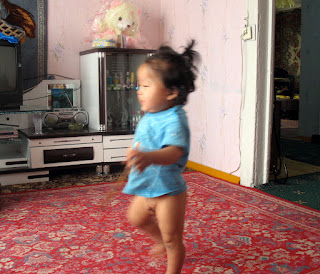
Babies tend to go running around without pants or diapers here…and they breast feed till way into toddler age! And those mothers are not very shy about where they “whip it out” (e.g. crowded meekers). However, I have to say I was fairly warned during orientation days in Darkhan the first week that we arrived in country. There was a whole session (demonstrated by a full on skit) of the Mongolian custom of “eat the penis”. Basically, the idea is that they “offer” you (the guest) to “eat the penis” by either holding up the baby – privates exposed – or making a mocking gesture of ‘transferring” the penis with their hand. All in all, I think it’s a Mongolian kept secret to make foreigners feel as uncomfortable as possible (a favorite Mongolian “custom”).

Thursday, June 14, 2007
The Difficulties of the Mongolian Language
Without fail, even when I nap from 8pm-midnight, when I finally emerge, my eej (mother) will ask me to bring out the current day’s language lesson and homework. Like moths to a flame, my ger buliinhen (family members) gather at the kitchen table surrounding me with their eagerness to help. Like little drill sergeants, they take turns correcting my “l-th” and “ts”. My efforts are rewarded with a happy “Sain!” (Good!) when I finally reach the correct pronunciation. Mongolian is hard. They seem disappointed when I tell them that that was it for today’s lesson; they would have me pronounce the whole English-Mongolian dictionary if I would let them.


Subscribe to:
Posts (Atom)




.JPG)