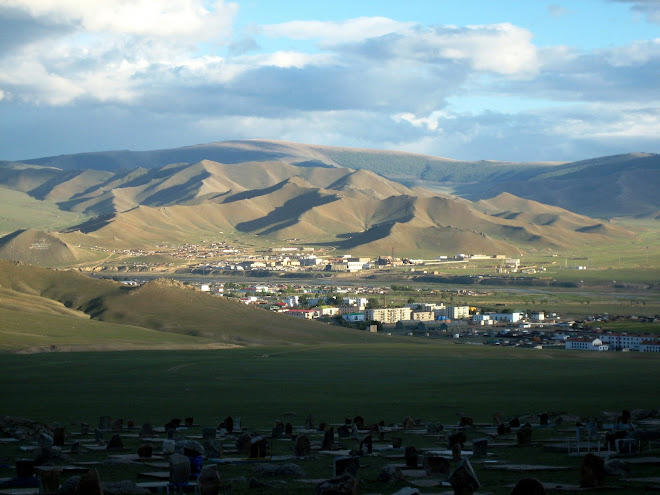
Burengiin Nuruu Mountain Range

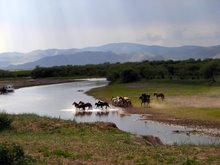
Burengiin Nuruu Mountain Range

History of the Peace Corps Program in Mongolia

Peace Corps began its program in Mongolia in 1991, the same year the US Embassy opened in Ulaanbaatar, the nation’s capital city. Since then, over 600 Peace Corps Volunteers have served in Mongolia as English language teachers trainers, English teachers, community economic developers, environmental educators, and health educators. I will be a member of the 18th group of Volunteers to serve in Mongolia and the 3rd group of Community Youth Development Volunteers (the 1st CYD Trainees came to Mongolia in June of 2005).

Country Assignment

  • Country: Mongolia (Outter)
  • Program: Youth Development
  • Job Title: Life Skills Trainer (also: English teacher, Child Caretaker, Fund Raiser, Events Organizer, and IT Trainer)
  • Orientation (Staging in Atlanta, GA): May 31-June 2, 2007
  • Pre-Service Training (in Darkhan and Sukhbaatar, Mongolia): June 3-August 18, 2007
  • Dates of Service (in Darkhan at Sun Children formerly "Asian Child Foundation" - a non-profit, non-government Japanese funded orphanage of 37 Mongolian children opened since 8/25/2005): August 19, 2007- August 18, 2009

Location and Nature of the Job

CYD Volunteers are placed in provincial centers with population between 15,000 and 70,000. A few CYD Volunteers are placed in Ulaanbaatar, where the population is reaching 1 million. I will work with youth-focused NGOs, children’s centers, schools, and civil society organizations to address major challenges confronting Mongolian youth today, such as education, life skills, employability, and leadership. In addition, the work will involve workshops and presentations at schools and community agencies and will entail traveling to other outlying communities that have less access to information and training. Given the vast distances in Mongolia, these visits will often require overnight stays.

Showing posts with label Host Family. Show all posts

Saturday, August 4, 2007

The Cultural Gift of a Del, Made With a Mother’s Loving Hands

For the past four days, my Mongolian host mother has been busy handmaking my del.

A brief interruption for a cultural explanation:
A del is the Mongol’s traditional garment worn on both workdays and special days. It is a long, loose gown cut one piece with the sleeves; it has a high collar and widely overlaps at the front. The del is girdled with a sash. Each ethnic group living in Mongolia has its own del distinguished by cut, color, and trimming. With the increase in European dress, especially with the women, the del has evolved to adapt to the frequent demands of the latest fashion, ranging in colors and choice of fabric as well as in the elegance of the cut and originality of the trimmings.

As I was saying, my host mother has been sewing my del on an old-fashion portable sewing machine that she hand-cranks with her right hand while pushing the material to be sewn (without the help of pins) with her left. I am amazed at how she manages to create perfect straight lines and design a dress pattern that fits flawlessly without the help of a measuring tape.

Watching her work, I am greatly reminded of my biological mother. My Mongolian host mother greatly resembles my Vietnamese biological mother. They both have a penchant for bubble gum colored lipstick. They both are masters at sewing, even owning similar old-fashion black sewing machines adorned with hand-painted flowers. Even their kisses are the same; the tender ‘sniff’ of the nose to the receiver’s cheek – a trait I had previously only associated to Vietnamese culture but now realized existed elsewhere; its origin remain unknown.

I am excited to wear the finish product, an honor I will save for my swearing-in ceremony in UB. Then, I will not only look the part of a Mongolian but I will feel like one too.

Thursday, July 19, 2007

Mongol Ook (Mongolian Fat)

Much to my dismay, I’ve realized that I’ve gained at least an additional five pounds since residing with my Mongolian host family (I later discovered that PC had informed the host families that Americans “eat a lot”). Since my arrival six and a half weeks ago, I have been fed – in large “American” portions – three times a day, everyday, seven days week promptly at 8:30am, 1:30pm and again at 7:30pm. Not the one to be culturally rude or inappropriate by not finishing my already set plate of food, I polish off every offering. Six weeks later and five pounds heavier, I walk into the kitchen one day to confront my host family: “Mongol Ook!” (“Mongolian Fat!”) I proclaimed while pinching my stomach-fat with both hands. They merely look at me and replied: “Mongol Ovog” (“Mongolian Winter”). With six months of winter at ungodly temperatures of 0 to -30 degrees C, I am a human-bear packing it on for the cold 6-8 months ahead.

Tuesday, July 17, 2007

Host Family Tragedy: A Death in the Family

My host family recently experienced a death in the family; my grandfather on my mother’s side pasted away three and a half weeks ago, a week before mid-LPI and mid-center days in Darkhan. His passing came at a very bad time for there was a series of ‘bad news’ events that happened around the same time (i.e. my other grandfather on my father’s side fell really ill and had to be taken to a hospital in UB, the family had received news that their pervious PCV had ET (Early Terminate)). I suppose the American saying “when it rains, it pours” is appropriate here. With the sudden trip to UB and the unexpected passing of my grandfather combined with my week long absence between mid-center days in Darkhan and CYD training at Summer Labor Camp near Erdenet, I hardly saw my family for over two weeks, especially my eej (mother). And when I did see her again – two and half weeks after her father had passed – she was (still) crying, laying in the living room covered with blankets and head compresses, inconsolable.

The funeral was held in the khodoo (countryside), where my grandfather had lived and died. Since the funeral took place the day before my mid-LPI and two days before I left for Darkhan, I could not attend. The night before the funeral, the remainder of my family – two younger brothers and a younger sister – left for the khodoo. Up to this point, it had only been my host parents who had been away to be with the rest of the other family members. I, in turn, was left in good hands; my brother’s friend stayed two nights to guard the house and my sister’s friend came by the morning to cook me breakfast, lunch, and dinner, and help me prepare for my mid-LPI then left to go back to her house.

This all had happened before I received cross-culture training in the rituals of Mongolian funerals and passings, thus, I had no idea of what to do or what to say, if anything. So I did the one thing that came to mind, I gave a sentimental ‘happy gift’, one that I was going to save until end of PST but decided that now was a better time; I gave the gift of photographs (Mongolians absolutely love photographs; digital cameras and personal computers are rare here so hand-held glossy photographs are still treasured). Seventeen beautifully developed colorful photographs of a family trip to the Mongolia-Russian boarder, the khodoo (which included horseback riding, goat chasing, Mongolian song singing, a ger visit), and a picnic in Sainnii Hutul Peak National Park. My pictures now sit in a photo album all by themselves and proudly brought out with every new visitor to the house.

Some are displayed below:


Friday, June 15, 2007

Culture Observation: Naked Babies

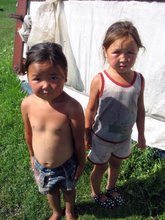
Babies tend to go running around without pants or diapers here…and they breast feed till way into toddler age! And those mothers are not very shy about where they “whip it out” (e.g. crowded meekers). However, I have to say I was fairly warned during orientation days in Darkhan the first week that we arrived in country. There was a whole session (demonstrated by a full on skit) of the Mongolian custom of “eat the penis”. Basically, the idea is that they “offer” you (the guest) to “eat the penis” by either holding up the baby – privates exposed – or making a mocking gesture of ‘transferring” the penis with their hand. All in all, I think it’s a Mongolian kept secret to make foreigners feel as uncomfortable as possible (a favorite Mongolian “custom”).

Thursday, June 14, 2007

The Difficulties of the Mongolian Language

Without fail, even when I nap from 8pm-midnight, when I finally emerge, my eej (mother) will ask me to bring out the current day’s language lesson and homework. Like moths to a flame, my ger buliinhen (family members) gather at the kitchen table surrounding me with their eagerness to help. Like little drill sergeants, they take turns correcting my “l-th” and “ts”. My efforts are rewarded with a happy “Sain!” (Good!) when I finally reach the correct pronunciation. Mongolian is hard. They seem disappointed when I tell them that that was it for today’s lesson; they would have me pronounce the whole English-Mongolian dictionary if I would let them.


Tuesday, June 12, 2007

Host Family Description

For the next ten weeks, I will be living in a four room wooden house, blue in color with an accompanying green roof. The interior of the house is decorated – from the walls to the bed and furniture to the floors – in colorful weaved rugs. Although there is electricity, there is no running water. The water is fetched, in a 15 gallon drum at a time, at the nearby well 100 meters from the house. The jorlon and a ‘sun shower’ (aka: outhouse and outshower) are outside and shared with the haashaa neighbor (haashaa = fence; some houses or gers share a common haashaa area in order to share resources, i.e. well, outshower, or garden). My room has the only bed and door in the house. The rest of the five member family sleep side-by-side on mats in the adjacent rooms.


My host dad is a telecom cable technician at the local post office. My host mom is a researcher at the nearby hospital; she has been working there for the past 27 years. My host parents are in their late-40s. I have three younger host siblings: two brothers and a sister. One brother is a recent college graduate of 23 who has moved back home in order to plan his next steps; a common move by young graduates in the States as well. The other brother is 19, attends college in UB and is working two jobs this summer for a little spending cash during the school year. My host sister is a sweet girly girl of 21 (her favorite color is pink, and she can’t go anywhere without her zebra-print heels). She, too, is a recent college graduate but her ambitions are higher; she will be going back to UB to pursue her MA and has plans of becoming a customs officer. Her ‘job’ this summer is to take care of me, a task that includes: meals at promptly 8:30am, 1:30pm and 7:30pm (times scheduled around my language and technical lessons at the nearby school) and Mongolian tutoring. My family seems wonderful and thoroughly accepting. My PST is off to a great start.

Recommended Books on Mongolia

  • “Dateline: An American Journalist in Nomad’s Land” by Michael Kohn, 2006.
  • "Ghengis Khan and the Making of the Modern World” by Jack Weatherford, 2004.
  • “Riding Windhorses” by Sarangerel, 2000.
  • “Twentieth Century Mongolia” by Baabar, 1999.

Recommended Mongolian Movies

  • The Story of the Weeping Camel (2004), Die Geschichte vom Weinenden Kamel
  • Mongolian Ping Pong (2005), Lü cao di