Let me try to answer some of your questions and update you on the pending situation.
1. How much more of your service do you have left? My COS (Completion of Service) date is August 18, 2009 (I arrived here June 4, 2007), however, I can leave as early as July 17, 2009. Therefore, I have about 6.5/7.5 months left in my service.
2. How would Early Termination (ET) affect you? What are the consequences and how would this affect your future job opportunities and/or career goals? If I ET, I would have to depart Mongolia immediately on the first flight back to my home of record (Sioux City, IA). Additionally, I loose all the benefits that would come if I were to complete my 27mos service. This includes: a year of non-competitive status when applying for employment in a federal position, a year of decreased cost of world-wide health insurance ($110/mo), eligibility in the various Masters International fellowships/grants that is associated with Peace Corps (specific programs in Public Health, Education, Agriculture, etc.), and, of course, a deduction of my $6000 resettlement allowance (which would be $4500 if I were to leave 6/7 months early. If I were to Field Termination (leave Peace Corps but able to remain Mongolia), I would lose all the above benefits, plus my work visa, and would not be given a free ticket back to the US or money in lieu of a ticket. Additionally, I would have to wait a period in order to receive any of my earned resettlement allowance.
Professionally, I don't think there would be negative repercussions if I were to leave Peace Corps 20 months into my service and/or if I were to apply to a government position in the future. 20 months is a significant amount of service already served; I would still include my service on my resume. As for the lost of benefits, Field Termination is not a likely option for I would loose a ticket home. I am not too worried about health insurance for I am still young and healthy (the coast is clear after Bangkok). The Masters International program is for specific programs or universities that I am not interested in (Master programs in International Relations in Western Europe and the East Coast are where my education interests lay). The only concern is the lost of money and, mostly, the lost of a non-competitive status in this hard economic time; federal jobs are more stable (and would be easier to obtain with a non-competitive status).
3. What are your responsibilities as a PCV? Are the wants of your agency within those responsibilities? To quote post (PC-Mongolia), my responsibilities as a PCV is up to the agency for "what the agency wants is what PC wants." There are guidelines, yes, but those guidelines are merely that. For instance, my home is supposed to be only 500 yards or less from my place of work, instead, it is a 45-minute walk (which gets very and tiring in the winter). I am only supposed to teach 8hrs/wk of English a week as a non-TELF volunteer, however, I teach 10 hrs/wk plus 6hrs/wk of TELF to the Director's son. I am supposed to work 30hrs/wk, but for the first 9 mos, I worked 40hrs/wk. I am supposed to work directly with another counter-part (co-worker, as to establish/enhance CP development) but ever since I started 20mos ago, all my daily teachings (with the exception of big projects) have been alone. Most volunteers only work Mon-Fri but for a period of time, my HCA had me working Saturdays. PC is aware of these things but, like I said, these guidelines are merely that, guidelines.
4. Have you talked to your fellow PCVs about your situation? Yes, I have talked to several of my fellow PCVs about my situation. I am not the first person within my M18 group nor Community Youth Development (CYD) group (7 originally, 5 remaining) that have quit or been fired from their HCAs. Unfortunately, most of the change in HCAs was a result of the PCV being fired from their agencies. Only in one case was the PCV allowed to quit. Just within my CYD sector (which is only in its 4th year), 2 PCVs have ET and 2 have changed agencies. Ironic isn't it that I would only be granted my wish to leave my agency (even part-time) only if I were bad enough to fire but not if I felt abusive?
5. To what point are you willing to bear the situation? Is it worth it? Is it possible to fight through the remaining time of your service or is the situation truly unbearable? Being a non-novice to abusive environments, I disagree with PC in their statement that a "hostile work environment for 10 hours a week is the same as 30 hours" (their reaction to my request to work part-time if I were not allowed to leave the HCA completely). This situation of continued micromanagement and verbal abuse has been ongoing for the past 10 months. I have talked to the Country Director (CD), written a proposal, met with perspective agencies as requested by the CP, had a meeting with higher management at post, and had a meeting to draft an "agreement" with my director, and even contacted PC Headquarters for advice/assistance. Throughout, I have been extremely flexible offering part-time if not complete separation from the HCA and even agreed to continue agreement discussions even though I was not informed of PC's decision to take off complete and/or partial HCA separation from the negotiations until I mentioned them at the agreement meeting. I have exhausted my options of what I can do in my limited status as a volunteer.
A summary: my call to the CD was made on 12/8/2009 after another verbal abuse incident. Perspective HCAs were contacted and met with during 12/9-12/12 at the request of the CD. A proposal was submitted on 12/15 at the request of the CD. A meeting with senior administrative staff to discuss the issue was on 12/15. A meeting with senior administrative staff with PCV present to personally defend her proposal was on 12/19. A meeting to draft an agreement between HCA director and PCV was on 12/22. A draft agreement has been pasted back and forth since 12/24.
The result: at the administrative meeting with the PCV, they rejected all my perspective HCAs and alternatives, stated that this type of authoritative and micro management style was a cultural difference and is a commonality among all Mongolian directors ("what makes you think that other directors would behave the same way if we let you switch agencies?"), and (in after I had left) denied my alterative to work part-time stating that "a hostile work environment for 10 hours is the same as a hostile work environment for 30 hours". Additionally, they wanted a meeting with the director and myself to draft an agreement.
The current situation: the said agreement is being passed back and forth for revisions because mostly because PC and I do not agree on the current consequences for breech of contact. A snippet of my latest communication with the Peace Corps Training Officer (PTO):
"Additionally, I want a guarantee from PC a similar administrative action for both parties in the case of a beech of contract. If I am facing possible Administrative Separation (a greater blemish on my professional resume than if I were to resign), then she too should face the same consequences such as a lost of a Peace Corps replacement volunteer for one year (I left this part for you to rewrite as I am not entirely satisfied with the current statement). I only have 7 months left of my service, thus, if a beech in contact will first be addressed in a conversation between the Director and I, followed by mediation with PC before these final actions take place, there will be no time for PC to find me a "suitable" replacement HCA. As you state, PC has to take into account "HCA counterparts, ability for capacity building, opportunity for primary goal work, and months left in service." Hence, I will be facing the possibility of Interrupted Service. As the agreement currently stands, I feel that I am being chastised for bringing the situation of a hostile work environment to your attention. I am agreeing to continue my association with my current HCA full-time (30 hours/week) despite the undoubted long lasting effects of such mental and emotional distress but would only do such if I was guaranteed that my Director not verbally abuse or continue such hostile work environment in the future. I respectfully request that you provide a revised consequence of breech of contract seeing as I desire to complete my term as a PCV."
In conclusion, family and friends, you might be seeing me again sooner than expected.
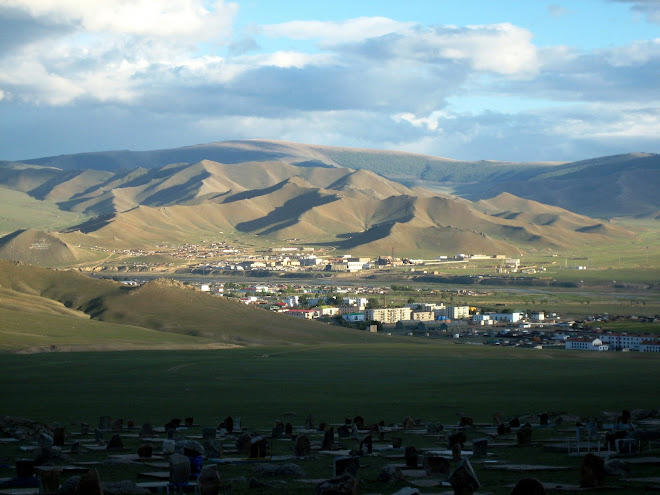
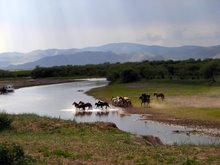
Burengiin Nuruu Mountain Range
Showing posts with label Confessions. Show all posts
Showing posts with label Confessions. Show all posts
Wednesday, January 7, 2009


Thursday, January 1, 2009
To quit or not to quit? That is the question.
Happy Holidays from the land of the bluest skies. It's those blue skies that bamboozle me into thinking the day is warmer than it really is. A recap. China in October was hectic trying to visit 9 cities in 21 days but it was a memorable experience; the culture, the food, the atmosphere from cities to villages. The only city I didn't care too
much for was Shanghai. I found it dirty and boring, although, it did have the best-bootlegged DVDs that I've encounter. I saw "Millers Crossing", "Johnny Basso", and "The 7th Seal" among other classics. I got back to UB to watch the elections at an open house for Americans hosted by the US Embassy. That election left me speechless still does.
After, I found out that I had to fly to Bangkok for a medical procedure that turned into two procedures and extended my stay for 12 days. I left four days before the "sit-in" protest happened at the airport. The extension may had something to do with major travel mishaps such as losing my plane ticket and having to fly directly back to Beijing from UB as the plane was about to touch down because of "smog." By the time I returned to Mongolia, it had been 7 weeks since I had last been at my site. Odd how I felt sitting in 95F degree weather in Bangkok wishing to return to Mongolia (and the cold). Everything turned out fine after the procedures but it was a potentially serious issue.
I returned back to site only to fall into the same hostile work environment sustained by my authoritative director. Mongolian directors have excessively much power here and get drunk on it. I decided that after 7 weeks away from site with 2 of that in the hospital, I wasn't about to come back and be yelled at like an irresponsible 17-year-old, so I called Peace Corps and asked if I could quit my agency and not have to Early Terminate. Despite the immense love for my children and co-workers, my director's micro management and overbearing presence has become intolerable. And, just like typical Peace Corps they wanted to have meetings and "discuss the options" and be diplomatic. After three weeks, we are still "discussing" it. Its bullshit. She has the choice to fire me at anytime. Federal law states that when en employee is in a hostile work environment, they have the option to switch departments within the company without quitting. I should be able to keep my federal rights as a citizen even after crossing country borders since I am still working for an American agency and a federal one at that. Sadly, the realization that I am not an employee but a volunteer, subject to one and one decision only, the decision to quit or not to quit, nothing more. So, after three meetings, one proposal and an agreement later, I am at that point, should I or should I not quit early? Advice on the situation if you were me?
much for was Shanghai. I found it dirty and boring, although, it did have the best-bootlegged DVDs that I've encounter. I saw "Millers Crossing", "Johnny Basso", and "The 7th Seal" among other classics. I got back to UB to watch the elections at an open house for Americans hosted by the US Embassy. That election left me speechless still does.
After, I found out that I had to fly to Bangkok for a medical procedure that turned into two procedures and extended my stay for 12 days. I left four days before the "sit-in" protest happened at the airport. The extension may had something to do with major travel mishaps such as losing my plane ticket and having to fly directly back to Beijing from UB as the plane was about to touch down because of "smog." By the time I returned to Mongolia, it had been 7 weeks since I had last been at my site. Odd how I felt sitting in 95F degree weather in Bangkok wishing to return to Mongolia (and the cold). Everything turned out fine after the procedures but it was a potentially serious issue.
I returned back to site only to fall into the same hostile work environment sustained by my authoritative director. Mongolian directors have excessively much power here and get drunk on it. I decided that after 7 weeks away from site with 2 of that in the hospital, I wasn't about to come back and be yelled at like an irresponsible 17-year-old, so I called Peace Corps and asked if I could quit my agency and not have to Early Terminate. Despite the immense love for my children and co-workers, my director's micro management and overbearing presence has become intolerable. And, just like typical Peace Corps they wanted to have meetings and "discuss the options" and be diplomatic. After three weeks, we are still "discussing" it. Its bullshit. She has the choice to fire me at anytime. Federal law states that when en employee is in a hostile work environment, they have the option to switch departments within the company without quitting. I should be able to keep my federal rights as a citizen even after crossing country borders since I am still working for an American agency and a federal one at that. Sadly, the realization that I am not an employee but a volunteer, subject to one and one decision only, the decision to quit or not to quit, nothing more. So, after three meetings, one proposal and an agreement later, I am at that point, should I or should I not quit early? Advice on the situation if you were me?
Wednesday, April 16, 2008
Questions from the Bi-Yearly Peace Corps Progress Report Questionnaire
- Please describe your biggest challenge during the past six months.
One of my biggest challenges was trying to implement the Peace Corps' primary goal of Capacity Building through trainings for CPs; it was like pulling teeth. As a non-profit that worked with vulnerable children that receives its funding through monetary and material donations from foreign organizations, it seemed to me that if a project idea did not have an immediate end result of a physical gain (i.e. money or material goods), then they were not interested in the training. Learning a new skills set (i.e. learning English or how to start up a small business), in which the end result was applying the new skill on your own, had no takers at this HCA. Maybe the reason lay in the type of agency or because of their lack of exposure to training and its benefits (as compared to a formal school where trainings are setup by the local Education Center) that was the cause of their lack interest.
Secondly, I did not really having a counterpart to work side by side with on projects. My only English-speaking CP, like most of my CPs, had a totally different job responsibility and work schedule than myself. My CPs are orphanage caretakers that worked a full day schedule plus a rotated a two overnight stay per week at the orphanage Mon-Sat while I worked a 9am-5pm workweek Mon-Fri. Thus, it was hard to coordinate time to work on projects together. She was merely my glorified translator.
- Over the past six months what have you done, or what ideas have you generated, to promote a better understanding of Mongolians on the part of Americans, both during and upon completion of your service? (Peace Corps' Goal 3)
I hope my daily interaction with my CPs and children have caused them to understand not only me but also my Western mindset and my "American" ways of approaching projects (e.g. potluck community meetings in my home, researching information through the internet, networking through meeting new people through people you already know) and teaching/training methods. Socially, I have invited my CPs over to my home for dinners and conversation (broken Mongolian combines with hand gestures and animated facial expressions goes a long ways). I have found that the key to quickly getting projects accomplished and ideas across is if you first build a personal connection with the people you are trying to work with.
- If you left Peace Corps tomorrow, what would you miss most about living and working in Mongolia?
I would miss the ancient monasteries and the landscape; being struck in awe at the magnificent of beauty in the rock formations, the endless blue sky, the rolling hills, the high mountains, the winding rivers, and the peacefulness of it all. Mongolia is so unique in its nomadic (aka: simple) way of living; I would miss that also. And I would miss my children dearly.
What I wouldn't miss is the daily smell of urine in my stairwell, the backup pipes in my poorly made Russian building that gives off a putrid smell, the careless littering combined with lack of an organized government trash pickup system, and the very, very packed meekers in an 8+ hour dirt road trip.
Saturday, March 8, 2008
Mercury Contamination and Poisonous Vodka
Days of -30C degrees, blizzarding snow storms, wearing yak tracks to prevent falling on ice, and eight hours of sunlight days are over. Spring has finally arrived after four months of endless cold and freezing temperatures. With Spring come dust storms, unpredictable weather, greatly varying temperatures, and the occasion snow storm the day one decides take off the long underwear. Nowhere in my invitation did Peace Corps mention having to don three layers of clothing at all times for half of the year in order to keep warm. Then again, I would have had second thoughts if they had.
This winter saw the scare of a possible mercury contamination in the local rivers due to illegal mining (and, thus, affecting the drinking water) in the provinces of Bayankhongor, Selenge and the city of Darkhan (where I am sited). This news put Peace Corps Mongolia in a frenzy collecting water samples to be tested by the National Inspection Agency. Although the results concluded that the levels were lower than the US standards set by the EPA, Hongor soum (which is only 20 minutes away from Darkhan) in the Selenge province, is rumored to be heavily affected with news of massive migration out of the area, deformed animals, and the inability to sale vegetables.
Additionally, January held the ban on the sale of vodka for the whole month. Although the 14 deaths by ingestion of dangerous levels of methanol (the 20% of 'waste' product produced during the distilling process before it becomes ethanol) where only found in Asian Wolf vodka products, the scare caused a country-wide alcohol sale ban (including beer and wine) that started from New Years to Tsaagan Sar (aka: Lunar New Year). The lost of alcohol in a country that heavily uses vodka to celebrate joyous occasions during the most important holiday of the year was a blow.
So the sacrifice of two of my frostbitten fingers to the Weather God only resulted in a transition into dust and wind storms. Although national crisises of possible mercury contamination in drinking water and country-wide alcohol ban due to death by poisonous vodka have become a normal way of life, I will never get use to the weather.
Monday, January 21, 2008
A Typical Monday in January
I hurried to get dressed, trying to remember my "warm formula"…one medium layer of thermals under the jeans, a thick layer of winter thermals over the jeans, an under shirt, two sweaters, a short length down coat, long thick wool scarf around my nose and mouth, a rabbit fur hat that covers my ears, two pairs of gloves, thick wool socks, sheep wool lined Ugg boots fitted with yak traks to keep from slipping on ice… I should hurry. My English class starts in an hour and a half and it's a 45-minute walk to the orphanage. No time for breakfast; I will have to wait until lunch when I eat with the kids. I leave some dried food out for the cats and walk out of my Russian style apartment building passing the trash lady in my cold graffiti ridden stairwell. I weave through New Darkhan through a shortcut of alleyways and narrow cracks between buildings. I ignore the holler of the meeker-seekers' "Yvax uu?" for I rather walk the long distance in -30C than pay 250T for a taxis ride one-way. My PC salary doesn't allow for such luxuries. I reach the long stretch of road that leads directly to the orphanage; I can see it in the distance. The field next to the road is barren so the wind blows extra hard during this stage of the walk. My throat and nose are being to hurt from breathing in the cold air. I pull my scarf tighter around my mouth. I finally reach the orphanage compound and walk through the main building. Khishgee, caretaker of the day, greets me and then asks why I am there. She then proceeds to tell me that all the teachers are on holiday that week, which includes me. Didn't I get the message? I had not though I've gotten used to being told important information at the very last minute. I put back on my scarf and start the cold journey back home.
Thursday, August 2, 2007
Adjustments and First Impressions
Some answers to general questions I’ve been asked and I’m sure are on your minds also:
1. Like it in Mongolia; been to the countryside or on a horse: yes, twice, and yes (getting better at holding on when they start to gallop unexpectedly).
2. First Impressions: too many to list them all but some are: (1) the sun is like the presence of God, shinning with intensity until 10pm; (2) there is a lack of trees and shade in general, coupled with impression #1 makes for a very hot summer; (3) Mongolians have a problem with littering; (4) with the lack of a public transportation system and paved roads, hitching is very common; (5) most Mongolians identify themselves as Buddhist but don’t actively practice.
3. Hardest to adjust to: frequent unexpected power surges that last for hours at a time and swatting to pee and poop, esp. those LONG poop sessions outside in pit toilets…I am NOT looking forward to such sessions during the upcoming winter.
4. How deep do the hole on those pit toilets go: depends on the ‘newness’ of the hole, if it was recently dug (then it would be about 10-15ft) or almost full (3-5ft). The only restrictions are: (1) must be located 20ft from the house, and (2) at least 20ft away from a natural water source.
5. Miss the most: paved roads and the feeling of riding on asphalt, indoor plumbing, and the cushions of a toilet seat.
6. Packing the right things: between the advice on packing from the current M17 group in the Mongolia Welcoming Book and my natural instincts, I did pretty well with the packing. However, I did pack for ger living (when in doubt, pack for the worse) but alas, it turns out that I most likely will be living in a heated, indoor plumbing, apartment in an aimag center (aka: providence capital). There goes the extra sleeping bag, solar shower bag, and endless supply of baby wipes.
1. Like it in Mongolia; been to the countryside or on a horse: yes, twice, and yes (getting better at holding on when they start to gallop unexpectedly).
2. First Impressions: too many to list them all but some are: (1) the sun is like the presence of God, shinning with intensity until 10pm; (2) there is a lack of trees and shade in general, coupled with impression #1 makes for a very hot summer; (3) Mongolians have a problem with littering; (4) with the lack of a public transportation system and paved roads, hitching is very common; (5) most Mongolians identify themselves as Buddhist but don’t actively practice.
3. Hardest to adjust to: frequent unexpected power surges that last for hours at a time and swatting to pee and poop, esp. those LONG poop sessions outside in pit toilets…I am NOT looking forward to such sessions during the upcoming winter.
4. How deep do the hole on those pit toilets go: depends on the ‘newness’ of the hole, if it was recently dug (then it would be about 10-15ft) or almost full (3-5ft). The only restrictions are: (1) must be located 20ft from the house, and (2) at least 20ft away from a natural water source.
5. Miss the most: paved roads and the feeling of riding on asphalt, indoor plumbing, and the cushions of a toilet seat.
6. Packing the right things: between the advice on packing from the current M17 group in the Mongolia Welcoming Book and my natural instincts, I did pretty well with the packing. However, I did pack for ger living (when in doubt, pack for the worse) but alas, it turns out that I most likely will be living in a heated, indoor plumbing, apartment in an aimag center (aka: providence capital). There goes the extra sleeping bag, solar shower bag, and endless supply of baby wipes.
Tuesday, July 31, 2007
A Cultural Miscommunication
A disadvantage of being Vietnamese-American is that my fellow Americans only perceive my ‘American’ side. Holding on tightly to their convictions like a child clutching a teddy bear, I am quickly categorized into the ‘born and raised in the US’ and ‘native English speaker’ categories. But I wasn’t and I’m not. Growing up as a Vietnamese immigrant, I struggled to define myself. To myself, I was a member of the ‘one-and-a-half’ generation, an insider and an outsider, both Vietnamese and American and yet neither simultaneously.
Representing the Peace Corps as an American only highlights my identity insecurities. Ironically, it is not the native Mongolians in this country that raise such issues to the surface but my fellow American PCTs. Maybe it is my young looking face and short twenty-seven years that makes them lump me into the same group experience category as themselves. I wouldn’t mind this inaccuracy too much if it didn’t cause problems, but, as it was in the States and amplified here in Mongolia, this inaccurate label is the root of some of my communication problems.
Nowadays, I speak English without an accent, comprehending the language my in a way my parents still do not. Nonetheless, as a habit of learning English as a second language, I interpret what people say literally and ask many questions to clarify meaning. But English is a tricky language. There are hidden meanings behind the literal words that a native speaker expects another native speaker to understand. And when I don’t, I am quickly tagged as dim-witted and promptly laughed at or worse, made an enemy. A former boyfriend once accused me of “not listening” – a phrase I have heard uttered more frequently in the past two months. My attempt at clarification only causes frustration on the side of the ‘real’ native speaker and such situations usually end in dust clouds of hasty departures.
How ironic is it that in a foreign country, half way around the world from the place that I call home, do I feel more comfortable and accepted then when I’m with fellow Americans.
Representing the Peace Corps as an American only highlights my identity insecurities. Ironically, it is not the native Mongolians in this country that raise such issues to the surface but my fellow American PCTs. Maybe it is my young looking face and short twenty-seven years that makes them lump me into the same group experience category as themselves. I wouldn’t mind this inaccuracy too much if it didn’t cause problems, but, as it was in the States and amplified here in Mongolia, this inaccurate label is the root of some of my communication problems.
Nowadays, I speak English without an accent, comprehending the language my in a way my parents still do not. Nonetheless, as a habit of learning English as a second language, I interpret what people say literally and ask many questions to clarify meaning. But English is a tricky language. There are hidden meanings behind the literal words that a native speaker expects another native speaker to understand. And when I don’t, I am quickly tagged as dim-witted and promptly laughed at or worse, made an enemy. A former boyfriend once accused me of “not listening” – a phrase I have heard uttered more frequently in the past two months. My attempt at clarification only causes frustration on the side of the ‘real’ native speaker and such situations usually end in dust clouds of hasty departures.
How ironic is it that in a foreign country, half way around the world from the place that I call home, do I feel more comfortable and accepted then when I’m with fellow Americans.
Thursday, July 19, 2007
"The Economist" Withdrawals
I am having some serious "The Economist" withdrawals. Side effects from living seven years in the center of world news and politics. Anyone, anyone at all that receives the subscription and has mercy on a poor volunteer in the middle of the bush please mail me your old subscriptions...
Wednesday, July 18, 2007
Safety and Security as a PCV in Mongolia: the Advantages of Looking Mongolian
The first time I meet my Mongolian host family, the second thing my host mother said to me was “you look Mongolian”, pointing to her daughter and gesturing the universal ‘same same’ sign (the first thing was “are you hungry?” though it was more of a rhetorical question for there was a banquet that awaited my arrival). Being Asian-American in an Asian country representing the United States as an American…well, let’s just say that I didn’t quite know how natives in my host country would react. Prior to my arrival to Mongolia, I had read first-hand accounts from RPCVs who served in Peace Corps Asian countries; they had written with the outer camouflage comes isolation (you don’t stand out as that ‘special American’) and confusion (on the part of the natives). I even worried if my host family would be disappointed because I wasn’t the typical looking “American” with my Mongolian-like features and dark colored hair.
Since my arrival in Mongolia, I have come to find that being mistaken for Mongolian has become of somewhat of an asset (I even have the same stylish fashion sense as Mongolian women; more on this later). While my fellow PCTs have had situations of harassment and difficulties as that “special American” that stands out like a sore thumb, I have gone unnoticed in my errands (e.g. visits to the bank, market, post office and internet café). I even get the “native discount” which is usually half of what they charge foreigners. However, since my Mongolian is still at a novice level, I immediately give myself away when I open my mouth to ask a question or to clarify a price, instantly revoking my ‘native discount’. This has happened enough times for me to keep quite, smile, and make a hasty departure. However, being the one that always gets spoken to when I’m with a group of my fellow PCV Americans (because they assume I am the sole Mongolian speaker), is getting a bit bothersome; apparently this asset comes with a silver lining.
Since my arrival in Mongolia, I have come to find that being mistaken for Mongolian has become of somewhat of an asset (I even have the same stylish fashion sense as Mongolian women; more on this later). While my fellow PCTs have had situations of harassment and difficulties as that “special American” that stands out like a sore thumb, I have gone unnoticed in my errands (e.g. visits to the bank, market, post office and internet café). I even get the “native discount” which is usually half of what they charge foreigners. However, since my Mongolian is still at a novice level, I immediately give myself away when I open my mouth to ask a question or to clarify a price, instantly revoking my ‘native discount’. This has happened enough times for me to keep quite, smile, and make a hasty departure. However, being the one that always gets spoken to when I’m with a group of my fellow PCV Americans (because they assume I am the sole Mongolian speaker), is getting a bit bothersome; apparently this asset comes with a silver lining.
Friday, May 11, 2007
When It Finally Hit Me
It started to hit me on the leg of my trip in Central America, three days before I had to fly back to Miami, five days before DC, 13 days before Atlanta and 16 days before Mongolia. The sadness hit hard like a smack in the face. There is no mix of emotions, no wave of a single feeling, just constant sadness; the kind that catches you off guard and overwhelms your senses and surroundings. This could not have come at a worse moment. In the middle of my island/tropics paradise, eating mangoes and dipping in natural hot springs - I have to deal with feelings of unexplained sadness.
Friday, April 20, 2007
"Are you excited?" "It hasn't hit me yet"
It will be five weeks come Monday till I arrive in the land of Genghis Khan. I am asked the same question when I inform others of my upcoming destination, “are you excited?” I give them the same answer I have been since I received my official country invitation to join the Peace Corps in Mongolia late February, “it hasn’t hit me yet.” And it still hasn’t. Not the increasing gap in time to departure, not when I was shopping at REI for winter sleeping bags, and not even when I knew I was saying “goodbye" for the next two and a half years to my love ones. I just hasn’t hit me yet.
Saturday, October 7, 2006
Too Old Too Soon
I am 26. I am restless, idealistic, romantic and fearless - the sub-definitions behind the word "young." So when did being in your late-20's signified "adulthood" - obtaining another degree to enhance career opportunities, settling down with one person, buying real-estate, investing in retirement plans and essentially giving up aspects that signify youth. What is the hurry to plant a permanent stake in a 7,000+ sq. ft. lot for 20+ years? Ironic that even though our generation - in comparison to our parent's and/or grandparents' generations - has an array of opportunities line up for us to choose, we still turn back to the traditional choices that limited previous generations. When did the concept of getting married and having a family have a timeline? Do we doubt ourselves so much as to say, "I need to lock down this person for they are the best I have found" in our mid-to-late 20's? Is it a blame on this increasingly conservative Western culture? Or is it a blame on our own personal insecurities? One can only wonder.
Sunday, July 16, 2006
The State of Purgatory
I'm at a point in my life that I never been at before. A plateau. Of purgatory. I've been stuck here for what seems like eternity but in actuality, only a bit over a year. Confused and in a haze, I move through life without much thought to the next step, to the future. For the future is a mirage. An image unclear and imaginary. And my imagination is broken. Broken from the inside out. I have my good and bad days. Then I have my unclear days. Those days are filled with fog. Ironically, this stage isn't filled with unemployment, bad breakups, lost or financial problems. Instead, I am actually content. Across the board - living situation, job, love (well, that area could always use some help), family and social life. The fog is instead filled with unanswered questions...answers only I could give. But I am all out of answers; I never had any to begin with. That is the quintessential problem. I don't know much longer this stage with last. I hope it ends soon.
Thursday, May 25, 2006
Apathetic
The seven deadly sins: gluttony, greed, pride, sloth, lust, envy, and wrath. There is this book that sits on my coffee table entitled: "Not Proud: A Smorgasbord of Shame." It is a collection of anonymous confessions - "the best and worst of human behavior" - categorized by the seven deadly sins. There exists another book - a traveling showcase that I've viewed - "Post Secret"; a similar concept of anonymous confessions illustrated on a 3.5 x 5 postcard. These peep show collections feeds our inner voyeur and distance us...just...enough...to feel good about ourselves. Yet, for all the high-level, quarter-of-a- million-dollars psychology education that I've received on the perils of human nature, can I understand it enough to understand myself.
Wednesday, May 17, 2006
Quarter Life Crisis
Utter state of confusion.
My peace corps application...like everything else, is on hold. seems like - for the first time - im scared to commit to something...anything. is this what being in your twenties is like?
My peace corps application...like everything else, is on hold. seems like - for the first time - im scared to commit to something...anything. is this what being in your twenties is like?
Subscribe to:
Posts (Atom)






.JPG)