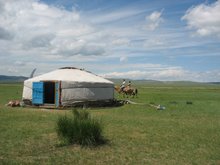
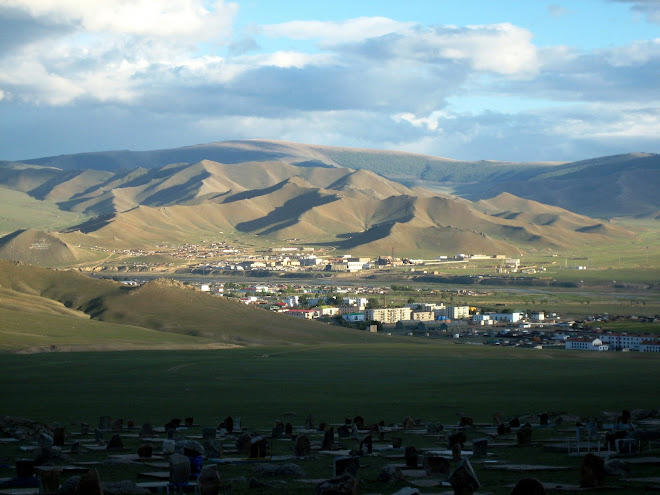
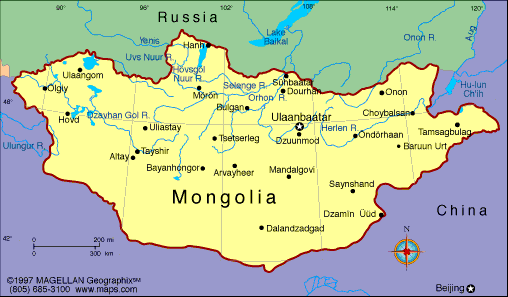
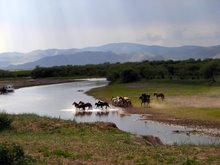
Burengiin Nuruu Mountain Range
Saturday, July 7, 2007
Culture Observation: The Popularity of Hair Dyeing
Hair dying is rather popular with Mongolians, changing their natural shade of black hair to the various hues of red, yellow, and brown. And the hair dying is not just a woman’s indulgence; the men too like the quick change of their looks that hair dyeing offers. I recall during one ger visit in the khodoo (countryside), when I looked up to reach for my airag (fermented mare’s milk) offering from my male Mongolian host (more on the rituals of visiting a ger later), I was struck by the intensity of his maroon hair – which could only come from a bottle.


Tuesday, July 3, 2007
Replacing One National Holiday for Another
Happy Independence Day! How odd it will be to celebrate an American holiday so very far away from the county it was meant to commemorate, especially having had celebrated the last seven 4th-of-Julys in Washington, DC. At least I will be amongst a large group of Americans, happy to introduce their fellow Mongolian neighbors to an American tradition. The next three days in Darkhan (away from our host communities) will be a nice break from the intensity of daily language classes and give everyone an opportunity to gather their bearings (i.e. check email that runs at “normal” speeds, stock up on hair conditioner at the local Nomans). The schedule includes a hot shower, ‘barbecue’ (there are rumors of hot dogs and pizza), basketball tournament (PST trainers vs. trainees; pictures from the tournament below), and evening festivities at the familiar Darkhan Hotel bar.
.jpg)
.jpg)
.jpg)
This day also marks the halfway point through PST (Pre-Service Training). The mid-LPIs (Language Proficiency Interviews) were given today (as practice for the final-LPIs in August). My Mongolian – after being in-country for over four weeks and three weeks of intensive language training at four hours a day/five days a week and living with a non-English speaking Mongolian family of five – is worse than my spoken Spanish. Knowing three previous languages before attempting to learn Mongolian actually leaves me at a disadvantage; my brain scrambles the vocabulary in one “dictionary” and what comes out is a combination of confusing phrases and sounds: “Muy Sain!”(Spanish-Mongolian). My tongue was not designed to pronounce “l-th” and “ts” sounds; I am doomed to sound like a blabbing foreigner in my site community for the next two years. For this, I am thankful that my program – CYD (Community Youth Development) – involves me working directly with children; they are far fairer judges of mistakes and blunders.
Naadam is also quickly approaching (July 11), a Mongolian national sports festival that celebrates the “three manly sports” – The Three Main Games of Men – of wrestling, archery, and horseracing. Under the old communist regime Naadam used to be preceded by military parades and workers’ demonstrations in central Ulan Bator’s Sukhbaatar Square (Сүхбаатарын талбай) to mark the anniversary of the establishment in 1921 of Mongolia’s revolutionary government. Nowadays, the three-day festival is held in the city stadium with a colorful ceremony combining national and quasi-religious elements.
Replacing one national holiday for another… Those wrestling underwear are another sight in themselves. I’ll post pictures of the festival as soon as I can.
.jpg)
.jpg)
.jpg)
This day also marks the halfway point through PST (Pre-Service Training). The mid-LPIs (Language Proficiency Interviews) were given today (as practice for the final-LPIs in August). My Mongolian – after being in-country for over four weeks and three weeks of intensive language training at four hours a day/five days a week and living with a non-English speaking Mongolian family of five – is worse than my spoken Spanish. Knowing three previous languages before attempting to learn Mongolian actually leaves me at a disadvantage; my brain scrambles the vocabulary in one “dictionary” and what comes out is a combination of confusing phrases and sounds: “Muy Sain!”(Spanish-Mongolian). My tongue was not designed to pronounce “l-th” and “ts” sounds; I am doomed to sound like a blabbing foreigner in my site community for the next two years. For this, I am thankful that my program – CYD (Community Youth Development) – involves me working directly with children; they are far fairer judges of mistakes and blunders.
Naadam is also quickly approaching (July 11), a Mongolian national sports festival that celebrates the “three manly sports” – The Three Main Games of Men – of wrestling, archery, and horseracing. Under the old communist regime Naadam used to be preceded by military parades and workers’ demonstrations in central Ulan Bator’s Sukhbaatar Square (Сүхбаатарын талбай) to mark the anniversary of the establishment in 1921 of Mongolia’s revolutionary government. Nowadays, the three-day festival is held in the city stadium with a colorful ceremony combining national and quasi-religious elements.
Replacing one national holiday for another… Those wrestling underwear are another sight in themselves. I’ll post pictures of the festival as soon as I can.
Tuesday, June 26, 2007
A Taste of Mongolian History: The Legend of Sukhbaatar
The provincial capital of Selenge, the name ‘Sukhbaatar’ translates to “Axe Hero”. In the center of Sukhbaatar square stands a statue of Damdin Sukhbaatar. Sukhbaatar is an important historical figure in Mongolian history, declaring Mongolia’s Independence from China in July 1921. His face dominates many currency notes and there are a number of things that bear his name: the provincial capital (aimag center) of Selenge, a providence (aimag), and a large square in the capital of UB. He was born in 1893, appointed Commander-in-Chief of the Mongolian People’s Revolutionary Army in 1921, and died in 1923 at the age of 30 – quite the busy guy.
One family trip was to Suhkbaatar’s grave and first work place: pictures below.
.JPG)
.JPG)
One family trip was to Suhkbaatar’s grave and first work place: pictures below.
.JPG)
.JPG)
Sunday, June 24, 2007


Saturday, June 23, 2007
A Mission to See Russia, Hiking
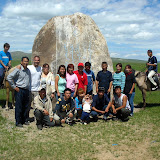
When a fellow PCT (Peace Corps Trainee; we are technically not volunteers until we officially swear-in after PST), Jason, asked me if I would be interested in going for a little hike on Saturday, I didn’t hesitate with my affirmation. This “little hike” turned out to be 2.5 hours of an uphill climb across three peaks to reach the endpoint goal of viewing Russia from the highest peak in Sukhbaatar.
Pictures from that day are below:
.jpg)
.jpg)
.JPG)
.jpg)
.JPG)
Pictures from that day are below:
.jpg)
.jpg)
.JPG)
.jpg)
.JPG)
Friday, June 15, 2007
Culture Observation: Naked Babies
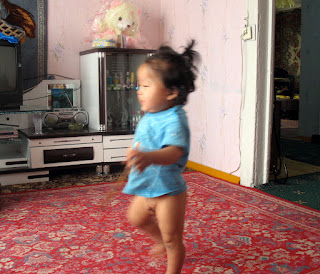
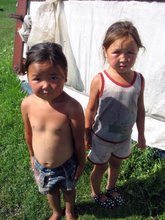
Babies tend to go running around without pants or diapers here…and they breast feed till way into toddler age! And those mothers are not very shy about where they “whip it out” (e.g. crowded meekers). However, I have to say I was fairly warned during orientation days in Darkhan the first week that we arrived in country. There was a whole session (demonstrated by a full on skit) of the Mongolian custom of “eat the penis”. Basically, the idea is that they “offer” you (the guest) to “eat the penis” by either holding up the baby – privates exposed – or making a mocking gesture of ‘transferring” the penis with their hand. All in all, I think it’s a Mongolian kept secret to make foreigners feel as uncomfortable as possible (a favorite Mongolian “custom”).

Subscribe to:
Posts (Atom)




.JPG)