Excerpt from the US Marines Humanitarian Civil Action Program grant proposal:
OBJECTIVE
To provide the children at the Asian Child Foundation orphanage in Darkhan with a sports field where they can occupy their time with play. Such play is the foundation for exercise and fitness as well as overall enjoyment. We propose to renovate the old existing basketball court with the installment of new basketball hoops and nets. In addition, we would like to build a sports field in the open grass area behind the orphanage. This sports field will include a volleyball court, a soccer field, and playground equipment (paralegal bars, a swing set, and a slide).
The success and completion of this project will require the physical cooperation of all 35 children, staff members, and the 330th Army. It is a project that only a community can complete, thus, in addition to providing the children an area where they can play, this project will provide the 330th Army an opportunity to interact with the some of the children that live in the community of Darkhan.
Pictures from the Welcoming Ceremony in late November
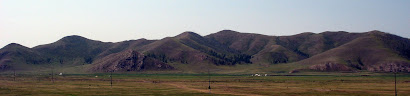
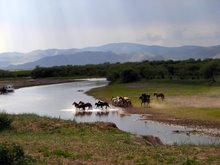
Burengiin Nuruu Mountain Range
Tuesday, November 20, 2007


Tuesday, October 30, 2007
The First Few Weeks At Site
The first few weeks at site were crazy. However, I was happy to finally be done with the 12 weeks of training and get to the heart of why I'm in Mongolia. Aside from the heticness of settling-in and getting adjusted, the orphanage got some visitors from Japan my first couple of weeks at site.
In my first week, 7 Japanese volunteers and 7 Mongolian volunteers arriving from a non-profit from UB for three days to help paint the orphanage buildings and repair the hashaa fence.
In my second week, we received a visit of Japanese investors (this orphanage was started and funded by foreign investors). The visit was a success and they signed a contact with my agency regarding funding for the orphanage (with funding specifically going to employee salaries and food and clothing for the children).
The third week was hectic trying to write a project/grant proposal for the US Marines Humanitarian Civil Action Program for a sports field to be built in the backyard of the orphanage. We busted our asses to get the proposal done in time. The US Embassy provided the funding to buy the materials and the 330th Mongolian Army will perform the labor. Seeing the project from start to completion was a bit frustrating at times; it is sometimes difficult trying to get things done on the project level here. However, apparently, it’s a fairly common phenomenon in Peace Corps worldwide. PC is fairly structure in procedures and progress reports but since PC is only half of the operation - the other half being the Host Country Agency - the productiveness lies in the hands of the HCA and not the PCV (Peace Corps Volunteer) most of the time. Luckily for me, I have a hard working Director that is on top of her game and everyone else's for that matter. I really lucked out on the pick for HCA.
In my first week, 7 Japanese volunteers and 7 Mongolian volunteers arriving from a non-profit from UB for three days to help paint the orphanage buildings and repair the hashaa fence.
In my second week, we received a visit of Japanese investors (this orphanage was started and funded by foreign investors). The visit was a success and they signed a contact with my agency regarding funding for the orphanage (with funding specifically going to employee salaries and food and clothing for the children).
The third week was hectic trying to write a project/grant proposal for the US Marines Humanitarian Civil Action Program for a sports field to be built in the backyard of the orphanage. We busted our asses to get the proposal done in time. The US Embassy provided the funding to buy the materials and the 330th Mongolian Army will perform the labor. Seeing the project from start to completion was a bit frustrating at times; it is sometimes difficult trying to get things done on the project level here. However, apparently, it’s a fairly common phenomenon in Peace Corps worldwide. PC is fairly structure in procedures and progress reports but since PC is only half of the operation - the other half being the Host Country Agency - the productiveness lies in the hands of the HCA and not the PCV (Peace Corps Volunteer) most of the time. Luckily for me, I have a hard working Director that is on top of her game and everyone else's for that matter. I really lucked out on the pick for HCA.
Wednesday, October 24, 2007
Rewind and Review: Host Agency Description
I apologize for the lengthy disappearance. The first few weeks at site was very busy, adjusting and settling-in. Then just when the hecticness died down, my laptop caught a nasty virus from a flash drive and preceded to take over all my programs and Windows operating system. I was in a state of near hysterics at this point; broken laptop is one thing but broken laptop in Mongolia when you speak Mongolian badly is a totally scary place to be. After six weeks and some bribing, happy to report that the laptop is up and running and, thus, resumes the blog postings (and pictures). Let me backtrack and rewind:
After swearing-in mid-August, I was sited to Darkhan, my Site Community (2nd largest city in Mongolia; there are only three cities) and assigned to the Asian Child Foundation, my Host Agency (www.happychild.mn only the Mongolian portion is up and running; the English version is still in the works via me). The ACF was founded in August 2005 and operates four programs, two in which I am directly involved with. The 1st is an orphanage that houses 35 children ages 7-19 years old. The hashaa compound (fenced-in area) consists of three buildings, two being the living quarters and the third the arts/language school where traditional Mongolian song and dance, Japanese, and English are taught. Here, I am an English teacher. I am also a child psychologist; I work alongside two other child psychologists. There is also big garden where the children grow their own vegetables, an outhouse, a hashaa dog and dog house, and a basketball court. Soon there will be a sports field (soccer filed, volleyball court, handle bars and swing area); an approved project/grant proposal (written by me within the first three weeks at site; an act of dumb luck, an opportunity taken at the right moment) in conjunction with the US Marines/US Embassy. The materials were brought with US Embassy money and labor provided by the 330rd Mongolian Army.
The 2nd program is the Kindergarten Program. This program provides funding for venerable 60 children ages 1-6 years old to attend the best kindergarten school in Darkhan. In addition to the tradition kindergarten programs that we have in the States, Mongolian kindergarten also acts as nursery; the children are schooled and housed there Monday-Fridays during the day and overnight as well and then are returned to their caretakers on the weekends. These children come from single parent families or families that are in hard financial and extreme living restrains.
That's currently my job, my care and for the first time, I have a job
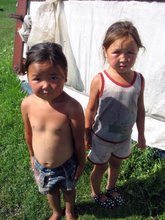
in which I truly feel satisfied. Below are pictures of my kids from the orphanage.


After swearing-in mid-August, I was sited to Darkhan, my Site Community (2nd largest city in Mongolia; there are only three cities) and assigned to the Asian Child Foundation, my Host Agency (www.happychild.mn only the Mongolian portion is up and running; the English version is still in the works via me). The ACF was founded in August 2005 and operates four programs, two in which I am directly involved with. The 1st is an orphanage that houses 35 children ages 7-19 years old. The hashaa compound (fenced-in area) consists of three buildings, two being the living quarters and the third the arts/language school where traditional Mongolian song and dance, Japanese, and English are taught. Here, I am an English teacher. I am also a child psychologist; I work alongside two other child psychologists. There is also big garden where the children grow their own vegetables, an outhouse, a hashaa dog and dog house, and a basketball court. Soon there will be a sports field (soccer filed, volleyball court, handle bars and swing area); an approved project/grant proposal (written by me within the first three weeks at site; an act of dumb luck, an opportunity taken at the right moment) in conjunction with the US Marines/US Embassy. The materials were brought with US Embassy money and labor provided by the 330rd Mongolian Army.
The 2nd program is the Kindergarten Program. This program provides funding for venerable 60 children ages 1-6 years old to attend the best kindergarten school in Darkhan. In addition to the tradition kindergarten programs that we have in the States, Mongolian kindergarten also acts as nursery; the children are schooled and housed there Monday-Fridays during the day and overnight as well and then are returned to their caretakers on the weekends. These children come from single parent families or families that are in hard financial and extreme living restrains.
That's currently my job, my care and for the first time, I have a job
in which I truly feel satisfied. Below are pictures of my kids from the orphanage.


Saturday, August 18, 2007
After Swearing In, Moving-In
Address: Building 1A, Apt #21, New Darkhan, Darkhan Uul, Darkhan Soum, Mongolia
Wednesday, August 8, 2007
Goodbye to Sukhbaatar, Goodbye My Host Community
Today is my last day in my host community; our group heads back to Darkhan tomorrow for final center days (and Host Family Appreciation Day which will include cultural performances by PCTs (us; had I mentioned earlier that these Mongolians like to deeply embarrass the foreigners?) and a waltz recital (they are really big on the waltz here; an apparent “survival skill” in the khodoo), and then to UB to swear-in on August 18 before scattering to our site communities for the next two years. It has been awhile since a group sweared-in in UB (usually, the ceremony is held in Darkhan) so pray that after six full days in the capital packed with indoor plumping, reliable electricity, a variety of foods and drinks (i.e. hamburgers, pizza, sushi, BBQ, and American beers) and other foreigners (international, not just Americans), our group will remain intact and not sitting in the Country Director’s office waiting for a plane ticket back to the States.
On another note, PST is over; the final LPIs (Language Proficiency Interviews) were given on Monday. I’ve gotten better in the language department; I learned enough “filler” words (i.e. then, and, because, but) to make full meaningful sentences instead of the kidde babble that I was spewing the first three weeks in-country. Although I will greatly miss living with my Mongolian host family (and being pampered and cared for), I am more than ready to be on my own and begin my service. PST is similar to experiencing high school all over again: cliques are formed, gossip is spread, bickering and complaining fluctuates with the heat, handwritten notes are passed, and alcohol debauchery is in fill swing. And, like high school, it is memorable but not an experience one wants to repeat.
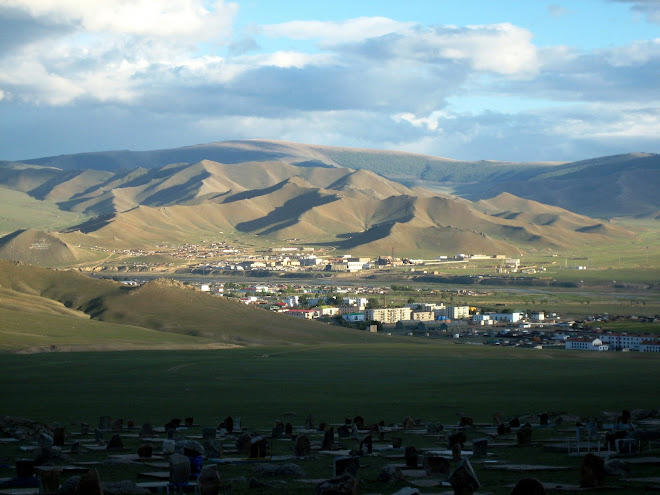
As an aide memoire to my host community of Sukhbaatar, I have attached some surrounding landscape pictures. A fellow PCT once described Sukhbaatar as:
“…2 paved roads and zero stoplights. There is an outdoor market attached to an indoor butcher and vegetable vendor. The butcher shop has meat out on counter tops, not refrigerated. Also, most of the butchering is done before your eyes. Cows freely roam around the grassy borders of the city square, and it is more common to see a man riding a horse around town than driving a car. The bars have people passed out in booths or on the bar at any hour of the day, and it is rare to see any kind of law enforcement or police.”
Salomon is correct in his first impressions, though, his first impressions overlook the underline charm that indeed exists within this town. In truth, it took me several weeks to notice it myself. It is in the lady who sells Russian ice cream at the market, the outdoor café that keeps Pringos on hand and blasts popular American music, the colorful jungle gyms that are randomly placed throughout town, the individually owned delguurs unique as the collection of foreign and local items they sell, the man holes without covers (for they have all be stolen to be melted and sold in China), and the occasional cow that freely roams untended. It is the little things that one notices when the first impressions fade away. It is the difference between a traveler and a resident…
I leave you with pictures.


On another note, PST is over; the final LPIs (Language Proficiency Interviews) were given on Monday. I’ve gotten better in the language department; I learned enough “filler” words (i.e. then, and, because, but) to make full meaningful sentences instead of the kidde babble that I was spewing the first three weeks in-country. Although I will greatly miss living with my Mongolian host family (and being pampered and cared for), I am more than ready to be on my own and begin my service. PST is similar to experiencing high school all over again: cliques are formed, gossip is spread, bickering and complaining fluctuates with the heat, handwritten notes are passed, and alcohol debauchery is in fill swing. And, like high school, it is memorable but not an experience one wants to repeat.
As an aide memoire to my host community of Sukhbaatar, I have attached some surrounding landscape pictures. A fellow PCT once described Sukhbaatar as:
“…2 paved roads and zero stoplights. There is an outdoor market attached to an indoor butcher and vegetable vendor. The butcher shop has meat out on counter tops, not refrigerated. Also, most of the butchering is done before your eyes. Cows freely roam around the grassy borders of the city square, and it is more common to see a man riding a horse around town than driving a car. The bars have people passed out in booths or on the bar at any hour of the day, and it is rare to see any kind of law enforcement or police.”
Salomon is correct in his first impressions, though, his first impressions overlook the underline charm that indeed exists within this town. In truth, it took me several weeks to notice it myself. It is in the lady who sells Russian ice cream at the market, the outdoor café that keeps Pringos on hand and blasts popular American music, the colorful jungle gyms that are randomly placed throughout town, the individually owned delguurs unique as the collection of foreign and local items they sell, the man holes without covers (for they have all be stolen to be melted and sold in China), and the occasional cow that freely roams untended. It is the little things that one notices when the first impressions fade away. It is the difference between a traveler and a resident…
I leave you with pictures.


Saturday, August 4, 2007
The Cultural Gift of a Del, Made With a Mother’s Loving Hands
For the past four days, my Mongolian host mother has been busy handmaking my del.
A brief interruption for a cultural explanation:
A del is the Mongol’s traditional garment worn on both workdays and special days. It is a long, loose gown cut one piece with the sleeves; it has a high collar and widely overlaps at the front. The del is girdled with a sash. Each ethnic group living in Mongolia has its own del distinguished by cut, color, and trimming. With the increase in European dress, especially with the women, the del has evolved to adapt to the frequent demands of the latest fashion, ranging in colors and choice of fabric as well as in the elegance of the cut and originality of the trimmings.
As I was saying, my host mother has been sewing my del on an old-fashion portable sewing machine that she hand-cranks with her right hand while pushing the material to be sewn (without the help of pins) with her left. I am amazed at how she manages to create perfect straight lines and design a dress pattern that fits flawlessly without the help of a measuring tape.
Watching her work, I am greatly reminded of my biological mother. My Mongolian host mother greatly resembles my Vietnamese biological mother. They both have a penchant for bubble gum colored lipstick. They both are masters at sewing, even owning similar old-fashion black sewing machines adorned with hand-painted flowers. Even their kisses are the same; the tender ‘sniff’ of the nose to the receiver’s cheek – a trait I had previously only associated to Vietnamese culture but now realized existed elsewhere; its origin remain unknown.
I am excited to wear the finish product, an honor I will save for my swearing-in ceremony in UB. Then, I will not only look the part of a Mongolian but I will feel like one too.

A brief interruption for a cultural explanation:
A del is the Mongol’s traditional garment worn on both workdays and special days. It is a long, loose gown cut one piece with the sleeves; it has a high collar and widely overlaps at the front. The del is girdled with a sash. Each ethnic group living in Mongolia has its own del distinguished by cut, color, and trimming. With the increase in European dress, especially with the women, the del has evolved to adapt to the frequent demands of the latest fashion, ranging in colors and choice of fabric as well as in the elegance of the cut and originality of the trimmings.
As I was saying, my host mother has been sewing my del on an old-fashion portable sewing machine that she hand-cranks with her right hand while pushing the material to be sewn (without the help of pins) with her left. I am amazed at how she manages to create perfect straight lines and design a dress pattern that fits flawlessly without the help of a measuring tape.
Watching her work, I am greatly reminded of my biological mother. My Mongolian host mother greatly resembles my Vietnamese biological mother. They both have a penchant for bubble gum colored lipstick. They both are masters at sewing, even owning similar old-fashion black sewing machines adorned with hand-painted flowers. Even their kisses are the same; the tender ‘sniff’ of the nose to the receiver’s cheek – a trait I had previously only associated to Vietnamese culture but now realized existed elsewhere; its origin remain unknown.
I am excited to wear the finish product, an honor I will save for my swearing-in ceremony in UB. Then, I will not only look the part of a Mongolian but I will feel like one too.

Thursday, August 2, 2007
Adjustments and First Impressions
Some answers to general questions I’ve been asked and I’m sure are on your minds also:
1. Like it in Mongolia; been to the countryside or on a horse: yes, twice, and yes (getting better at holding on when they start to gallop unexpectedly).
2. First Impressions: too many to list them all but some are: (1) the sun is like the presence of God, shinning with intensity until 10pm; (2) there is a lack of trees and shade in general, coupled with impression #1 makes for a very hot summer; (3) Mongolians have a problem with littering; (4) with the lack of a public transportation system and paved roads, hitching is very common; (5) most Mongolians identify themselves as Buddhist but don’t actively practice.
3. Hardest to adjust to: frequent unexpected power surges that last for hours at a time and swatting to pee and poop, esp. those LONG poop sessions outside in pit toilets…I am NOT looking forward to such sessions during the upcoming winter.
4. How deep do the hole on those pit toilets go: depends on the ‘newness’ of the hole, if it was recently dug (then it would be about 10-15ft) or almost full (3-5ft). The only restrictions are: (1) must be located 20ft from the house, and (2) at least 20ft away from a natural water source.
5. Miss the most: paved roads and the feeling of riding on asphalt, indoor plumbing, and the cushions of a toilet seat.
6. Packing the right things: between the advice on packing from the current M17 group in the Mongolia Welcoming Book and my natural instincts, I did pretty well with the packing. However, I did pack for ger living (when in doubt, pack for the worse) but alas, it turns out that I most likely will be living in a heated, indoor plumbing, apartment in an aimag center (aka: providence capital). There goes the extra sleeping bag, solar shower bag, and endless supply of baby wipes.
1. Like it in Mongolia; been to the countryside or on a horse: yes, twice, and yes (getting better at holding on when they start to gallop unexpectedly).
2. First Impressions: too many to list them all but some are: (1) the sun is like the presence of God, shinning with intensity until 10pm; (2) there is a lack of trees and shade in general, coupled with impression #1 makes for a very hot summer; (3) Mongolians have a problem with littering; (4) with the lack of a public transportation system and paved roads, hitching is very common; (5) most Mongolians identify themselves as Buddhist but don’t actively practice.
3. Hardest to adjust to: frequent unexpected power surges that last for hours at a time and swatting to pee and poop, esp. those LONG poop sessions outside in pit toilets…I am NOT looking forward to such sessions during the upcoming winter.
4. How deep do the hole on those pit toilets go: depends on the ‘newness’ of the hole, if it was recently dug (then it would be about 10-15ft) or almost full (3-5ft). The only restrictions are: (1) must be located 20ft from the house, and (2) at least 20ft away from a natural water source.
5. Miss the most: paved roads and the feeling of riding on asphalt, indoor plumbing, and the cushions of a toilet seat.
6. Packing the right things: between the advice on packing from the current M17 group in the Mongolia Welcoming Book and my natural instincts, I did pretty well with the packing. However, I did pack for ger living (when in doubt, pack for the worse) but alas, it turns out that I most likely will be living in a heated, indoor plumbing, apartment in an aimag center (aka: providence capital). There goes the extra sleeping bag, solar shower bag, and endless supply of baby wipes.
Subscribe to:
Posts (Atom)






.JPG)