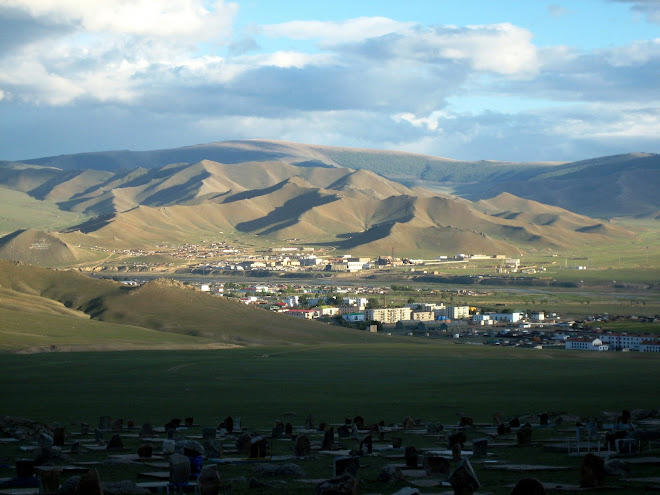
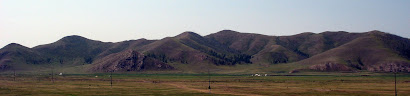
Burengiin Nuruu Mountain Range
Friday, July 20, 2007


The Pressures of Alcohol in Mongolian Culture and How to Properly Accept a Vodka Offering
The subject of alcohol pressure and alcohol consumption in Mongolia had thoroughly been discussed prior to our arrival into our host communities. Warnings were given and demonstration of alcohol refusal was shown but wouldn’t you know it, it did no good. It is not easy to convince a Mongolian that you do not want to drink alcohol. Rather than make excuses and getting called ‘muu’ (‘bad’, which has happened several times), it is much easier to go through the motions, put the cup to my lips, sip as much as I can bear and pass the cup back to my host. Elders instruct the youth to: “Taste alcohol barely in the prime of life”; Drink alcohol moderately in the maturity of life”; Drink alcohol enjoyably in older age,” however, the actual practice is a bit different.
When one is offered vodka (before the first round for it is also tradition to take three rounds of vodka; one cannot just get away with the courtesy one shot), there is a short ritual to honor Father Heaven, Mother Earth, and the ancestors. The ritual goes: dip your ring finger of your right hand (‘yadam khuruu’) into the glass, and lightly flick a drip once towards the sky, once towards the air ‘to the wind’ and once to the ground, and end with a wipe across your forehead. This expresses the following meaning:
Be serene, the blue sky!
Be calm, the hole earth!
Be contented, humankind!
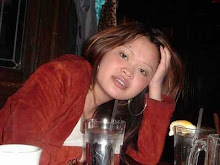
Food and drink are accepted with the right hand; the left hand is only used to support the right elbow. Similarly, offerings are presented this way as well. Demonstration picture below (although this picture is slightly wrong – you can tell we are still in the learning stages; the host usually has the offering poured before presenting it, never does he let the guest hold the glass while he pours).

When one is offered vodka (before the first round for it is also tradition to take three rounds of vodka; one cannot just get away with the courtesy one shot), there is a short ritual to honor Father Heaven, Mother Earth, and the ancestors. The ritual goes: dip your ring finger of your right hand (‘yadam khuruu’) into the glass, and lightly flick a drip once towards the sky, once towards the air ‘to the wind’ and once to the ground, and end with a wipe across your forehead. This expresses the following meaning:
Be serene, the blue sky!
Be calm, the hole earth!
Be contented, humankind!
Food and drink are accepted with the right hand; the left hand is only used to support the right elbow. Similarly, offerings are presented this way as well. Demonstration picture below (although this picture is slightly wrong – you can tell we are still in the learning stages; the host usually has the offering poured before presenting it, never does he let the guest hold the glass while he pours).

Thursday, July 19, 2007
"The Economist" Withdrawals
I am having some serious "The Economist" withdrawals. Side effects from living seven years in the center of world news and politics. Anyone, anyone at all that receives the subscription and has mercy on a poor volunteer in the middle of the bush please mail me your old subscriptions...
Mongol Ook (Mongolian Fat)
Much to my dismay, I’ve realized that I’ve gained at least an additional five pounds since residing with my Mongolian host family (I later discovered that PC had informed the host families that Americans “eat a lot”). Since my arrival six and a half weeks ago, I have been fed – in large “American” portions – three times a day, everyday, seven days week promptly at 8:30am, 1:30pm and again at 7:30pm. Not the one to be culturally rude or inappropriate by not finishing my already set plate of food, I polish off every offering. Six weeks later and five pounds heavier, I walk into the kitchen one day to confront my host family: “Mongol Ook!” (“Mongolian Fat!”) I proclaimed while pinching my stomach-fat with both hands. They merely look at me and replied: “Mongol Ovog” (“Mongolian Winter”). With six months of winter at ungodly temperatures of 0 to -30 degrees C, I am a human-bear packing it on for the cold 6-8 months ahead.
Wednesday, July 18, 2007
Safety and Security as a PCV in Mongolia: the Advantages of Looking Mongolian
The first time I meet my Mongolian host family, the second thing my host mother said to me was “you look Mongolian”, pointing to her daughter and gesturing the universal ‘same same’ sign (the first thing was “are you hungry?” though it was more of a rhetorical question for there was a banquet that awaited my arrival). Being Asian-American in an Asian country representing the United States as an American…well, let’s just say that I didn’t quite know how natives in my host country would react. Prior to my arrival to Mongolia, I had read first-hand accounts from RPCVs who served in Peace Corps Asian countries; they had written with the outer camouflage comes isolation (you don’t stand out as that ‘special American’) and confusion (on the part of the natives). I even worried if my host family would be disappointed because I wasn’t the typical looking “American” with my Mongolian-like features and dark colored hair.
Since my arrival in Mongolia, I have come to find that being mistaken for Mongolian has become of somewhat of an asset (I even have the same stylish fashion sense as Mongolian women; more on this later). While my fellow PCTs have had situations of harassment and difficulties as that “special American” that stands out like a sore thumb, I have gone unnoticed in my errands (e.g. visits to the bank, market, post office and internet café). I even get the “native discount” which is usually half of what they charge foreigners. However, since my Mongolian is still at a novice level, I immediately give myself away when I open my mouth to ask a question or to clarify a price, instantly revoking my ‘native discount’. This has happened enough times for me to keep quite, smile, and make a hasty departure. However, being the one that always gets spoken to when I’m with a group of my fellow PCV Americans (because they assume I am the sole Mongolian speaker), is getting a bit bothersome; apparently this asset comes with a silver lining.
Since my arrival in Mongolia, I have come to find that being mistaken for Mongolian has become of somewhat of an asset (I even have the same stylish fashion sense as Mongolian women; more on this later). While my fellow PCTs have had situations of harassment and difficulties as that “special American” that stands out like a sore thumb, I have gone unnoticed in my errands (e.g. visits to the bank, market, post office and internet café). I even get the “native discount” which is usually half of what they charge foreigners. However, since my Mongolian is still at a novice level, I immediately give myself away when I open my mouth to ask a question or to clarify a price, instantly revoking my ‘native discount’. This has happened enough times for me to keep quite, smile, and make a hasty departure. However, being the one that always gets spoken to when I’m with a group of my fellow PCV Americans (because they assume I am the sole Mongolian speaker), is getting a bit bothersome; apparently this asset comes with a silver lining.
Tuesday, July 17, 2007
Host Family Tragedy: A Death in the Family
My host family recently experienced a death in the family; my grandfather on my mother’s side pasted away three and a half weeks ago, a week before mid-LPI and mid-center days in Darkhan. His passing came at a very bad time for there was a series of ‘bad news’ events that happened around the same time (i.e. my other grandfather on my father’s side fell really ill and had to be taken to a hospital in UB, the family had received news that their pervious PCV had ET (Early Terminate)). I suppose the American saying “when it rains, it pours” is appropriate here. With the sudden trip to UB and the unexpected passing of my grandfather combined with my week long absence between mid-center days in Darkhan and CYD training at Summer Labor Camp near Erdenet, I hardly saw my family for over two weeks, especially my eej (mother). And when I did see her again – two and half weeks after her father had passed – she was (still) crying, laying in the living room covered with blankets and head compresses, inconsolable.
The funeral was held in the khodoo (countryside), where my grandfather had lived and died. Since the funeral took place the day before my mid-LPI and two days before I left for Darkhan, I could not attend. The night before the funeral, the remainder of my family – two younger brothers and a younger sister – left for the khodoo. Up to this point, it had only been my host parents who had been away to be with the rest of the other family members. I, in turn, was left in good hands; my brother’s friend stayed two nights to guard the house and my sister’s friend came by the morning to cook me breakfast, lunch, and dinner, and help me prepare for my mid-LPI then left to go back to her house.
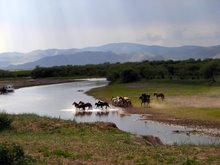
This all had happened before I received cross-culture training in the rituals of Mongolian funerals and passings, thus, I had no idea of what to do or what to say, if anything. So I did the one thing that came to mind, I gave a sentimental ‘happy gift’, one that I was going to save until end of PST but decided that now was a better time; I gave the gift of photographs (Mongolians absolutely love photographs; digital cameras and personal computers are rare here so hand-held glossy photographs are still treasured). Seventeen beautifully developed colorful photographs of a family trip to the Mongolia-Russian boarder, the khodoo (which included horseback riding, goat chasing, Mongolian song singing, a ger visit), and a picnic in Sainnii Hutul Peak National Park. My pictures now sit in a photo album all by themselves and proudly brought out with every new visitor to the house.
Some are displayed below:
.jpg)
.jpg)
.JPG)
.jpg)

The funeral was held in the khodoo (countryside), where my grandfather had lived and died. Since the funeral took place the day before my mid-LPI and two days before I left for Darkhan, I could not attend. The night before the funeral, the remainder of my family – two younger brothers and a younger sister – left for the khodoo. Up to this point, it had only been my host parents who had been away to be with the rest of the other family members. I, in turn, was left in good hands; my brother’s friend stayed two nights to guard the house and my sister’s friend came by the morning to cook me breakfast, lunch, and dinner, and help me prepare for my mid-LPI then left to go back to her house.
This all had happened before I received cross-culture training in the rituals of Mongolian funerals and passings, thus, I had no idea of what to do or what to say, if anything. So I did the one thing that came to mind, I gave a sentimental ‘happy gift’, one that I was going to save until end of PST but decided that now was a better time; I gave the gift of photographs (Mongolians absolutely love photographs; digital cameras and personal computers are rare here so hand-held glossy photographs are still treasured). Seventeen beautifully developed colorful photographs of a family trip to the Mongolia-Russian boarder, the khodoo (which included horseback riding, goat chasing, Mongolian song singing, a ger visit), and a picnic in Sainnii Hutul Peak National Park. My pictures now sit in a photo album all by themselves and proudly brought out with every new visitor to the house.
Some are displayed below:
.jpg)
.jpg)
.JPG)
.jpg)

Wednesday, July 11, 2007
Naadam – “The Three Manly Sports” (Erinn Gurvan Naadam)
1. Wrestling
Wrestling is national sport of Mongolia; it is the highlight of the Three Games of Men during Naadam (July 11-13). There are no weight categories or age limits in Mongolian national wrestling and during Naadam, every willing and curious man is given an equal chance to compete (including the American PC boys of Dulaankhaan host community; video footage link yet to be posted). The wrestlers wear heavy boots, a very small tight-fitting loincloth, a pair of sleeves which meet across the back of the shoulders resembling a tiny vestige of a jacket, and a pointed cap of velvet. It is rumored that this “uniform” came to be because during one Naadam, a woman had beaten all the contestants (wrestling is the one sport during Naadam that is reserved only for men to participate). The contestants come out on the field leaping and dancing, flapping their arms in imitation of an eagle (the “Eagle Dance”), then slaps with both hands his thighs and buttocks – a sign to his opponent that he is ready to begin.


2. Horse Racing
Mongolia’s second-biggest sport is horse racing. Jockeys are children between the ages of five and 12 (Mongolian children have been riding since infancy; “The nomad is born in the saddle”), racing their horses over open countryside rather than around a track; courses range from 15km-30km, depending on the age of the horses. The winning horse receives the honorary tile of ‘tumnii ek’ or ‘leader of 10,000’.


3. Archery
Archers use a bent composite bow made of layered horn, bark and wood. Arrows are made of willow and feathers from vultures and other birds of prey. The distance is 75m for men and 60m for women. Men shoot 40 arrows and must score greater than 15 points; women shoot 20 arrows and must score great than 13 points using the same bow. The winner earns the title of ‘mergeb’ or ‘super marksman’.
Wrestling is national sport of Mongolia; it is the highlight of the Three Games of Men during Naadam (July 11-13). There are no weight categories or age limits in Mongolian national wrestling and during Naadam, every willing and curious man is given an equal chance to compete (including the American PC boys of Dulaankhaan host community; video footage link yet to be posted). The wrestlers wear heavy boots, a very small tight-fitting loincloth, a pair of sleeves which meet across the back of the shoulders resembling a tiny vestige of a jacket, and a pointed cap of velvet. It is rumored that this “uniform” came to be because during one Naadam, a woman had beaten all the contestants (wrestling is the one sport during Naadam that is reserved only for men to participate). The contestants come out on the field leaping and dancing, flapping their arms in imitation of an eagle (the “Eagle Dance”), then slaps with both hands his thighs and buttocks – a sign to his opponent that he is ready to begin.


2. Horse Racing
Mongolia’s second-biggest sport is horse racing. Jockeys are children between the ages of five and 12 (Mongolian children have been riding since infancy; “The nomad is born in the saddle”), racing their horses over open countryside rather than around a track; courses range from 15km-30km, depending on the age of the horses. The winning horse receives the honorary tile of ‘tumnii ek’ or ‘leader of 10,000’.


3. Archery
Archers use a bent composite bow made of layered horn, bark and wood. Arrows are made of willow and feathers from vultures and other birds of prey. The distance is 75m for men and 60m for women. Men shoot 40 arrows and must score greater than 15 points; women shoot 20 arrows and must score great than 13 points using the same bow. The winner earns the title of ‘mergeb’ or ‘super marksman’.
Subscribe to:
Posts (Atom)




.JPG)